

Renewing Our Minds, Bodies and Spirits: Strongholds
We are entering week three of our study, Renewing Our Minds, Bodies, and Spirits, and this week we are going to look at another heavier topic: strongholds.
This lesson is going to be a lot like the one we did a year ago on strongholds, so if you were with us last year, it will be familiar, but this year we are approaching the entire year holistically. What that means is that we are going to be working on our biggest goals and biggest struggles, all throughout the year, holding one another accountable, offering support, and chipping away at the changes we want to make.
Because of that approach, we really want to address strongholds early, so that we can be working to break our strongholds- together- the entire year.
First, as always, a quick reminder on ACT therapy, our “umbrella” approach to mental health:
- ACT therapy stands for Acceptance and Commitment Therapy.
- We use acceptance because the goal is to develop psychological flexibility, which means being able to ride the waves of challenging emotions and experiences, without trying to fix them or run away from them. Acceptance is about saying “This is what I am dealing with and while I may not like it, I can allow it in the name of my mental and emotional well-being.”
- Mindfulness is the practice of getting grounded, calm, and centered even as we face difficult emotions, so that we are in a better place to make decisions and take action.
- And the Commitment part of ACT is about committing to take action, and choosing to move forward and move towards a purpose-filled, values-based life, even while dealing with challenging emotions and situations.
There are lots and lots of ACT resources all over this website, so if you’d like more info, it’s here for you!
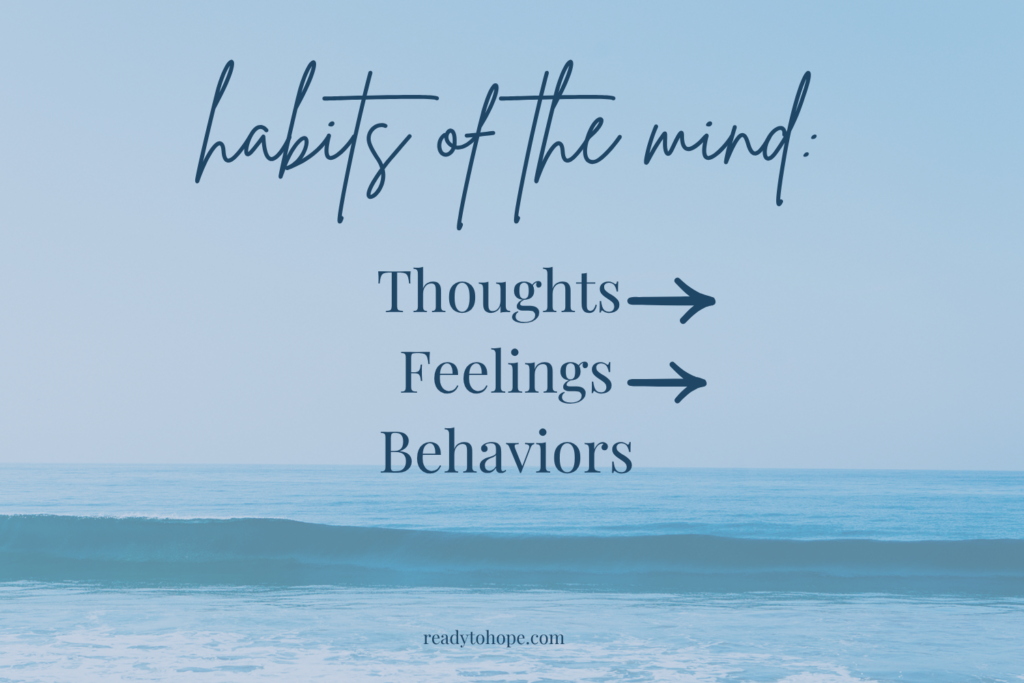
Next, let’s revisit the idea of neuroplasticity and the habits of the mind
One important principle we like to stay connected to in our work together is the following:
Our thoughts influence our feelings
And our feelings often influence our choices
So if you feel sad, for example, it often begins with a thought. Maybe it’s that you saw your friend got engaged on social media, and you’ve been wanting a partner for a long time.
You have the thought: I wish I had that.
The feeling follows: sadness.
And often an action follows the feeling: maybe you dive into the ice cream, or have a cocktail, or even pursue a relationship with someone you know isn’t healthy.
Thought. Feeling. Action.
And here’s what’s great: while feelings sometimes are out of our control, our thoughts are in our control!
It isn’t easy, but it is still the truth: you can choose a different thought, and when you do, you will get a different feeling, and likely choose a different action!
Neuroplasticity is how God made our brains to help us choose different thoughts.
God actually made our brains in such a way that we can, with practice and repetition, form new pathways in our brains!
So if you’ve consistently thought when seeing your friend got engaged: “I wish I had that,” and that has made you feel sad, you can practice choosing a different thought.
If you were to, with practice, choose to say “I know my time will come,” then you would over time build that muscle memory in your brain, and over time, you would have a different feeling!
Neuroplasticity is a gift from God!
Let’s now look at strongholds
Now that we know that our thoughts influence how we feel, and we know that we have the power to change our thoughts and therefore change how we feel, we have a solid foundation for discussing our strongholds.
Strongholds are a heavy topic, but we are going to address them with hope and tools!
Strongholds are lies you believe, that keep you stuck.
Lies are thoughts. Strongholds are built on thoughts that keep us stuck.
So strongholds are thoughts we have, that don’t serve us, and that are often rooted in past hurts or thought patterns.
Essentially, we believe lies that run counter to what God intends for us, which make us feel a certain way, which often lead to behaviors we don’t really want to be choosing.
If you watched your parents argue a lot, you may believe the lie that no relationship can be healthy, and then you may choose partners that aren’t good for you.
If you grew up being forced to be independent, you may believe that you have to stay independent, and then you may protect yourself from letting others get close to you.
If you had a highly critical parent or parents, you may believe that your worth is based on being perfect, and constantly strive for perfection, only to of course not measure up, and then beat yourself up for your inability to be perfect.
Are you seeing how strongholds are formed, and how they hurt us?
We are working to continually renew our minds, to take the right kinds of thoughts captive, and strongholds are the opposite: they are places where we have taken unhealthy thoughts captive and struggle to renew our minds to fight against those thoughts.
Another helpful foundational concept for our studies together is cognitive fusion.
Cognitive fusion is a helpful ACT concept, because it can help us look at our struggles in a new light, but also definitely relates to our strongholds.
Cognitive fusion is the process of getting so entangled with thoughts that you see them as literal truths rather than just mental events.
Can you see the parallels with strongholds?
Cognitive fusion is what is happening when you are telling yourself a story that may or may not even be true, and then feeling feelings that get in your way.
It might look like: your friends stop responding to your texts. You assume that if they’re not talking to you, somehow you’ve done something wrong, or they’re talking about you behind your back, and you suddenly feel upset, sad, and a little angry.
The story may or may not be true, but you are now tied up in it, and feeling all sorts of feelings as a result.
When you find yourself really struggling with a situation that you wish would change, and you just keep thinking about it and it gets in the way of you functioning in a healthy manner, you are probably experiencing cognitive fusion.
Terms that are similar to or can help you understand cognitive fusion are:
- Crashing out
- Spinning out
- Melting down
- Feeling stuck
And all of this is based on a story! It’s based on thoughts you are having- that you have the power to change!
So, strongholds and cognitive fusion are very similar. Not everything you fuse with is a stronghold, that’s important to note. However, the tools to tackle strongholds and cognitive fusion will have a lot of overlap.
So, let’s look at some ACT tools for overcoming our strongholds and cognitive fusion, and then we will look at what we can learn from scripture!
ACT tools for strongholds and cognitive fusion
Since ACT is all about learning to ride the waves of our emotions, it makes sense that ACT is going to focus on defusing from our thoughts.
If fusion is being tangled up, defusing is about untangling.
The goal here: gain a little distance from the thought that has you stuck or spinning out or stressed or anxious or any other emotion that feels challenging.
First: you can recognize that the thought is just a thought.
You are not the thought! You are the one having the thought. Simply recognizing that you are having a thought is the first step to gaining some distance.
It can be as simple as replacing, “I feel stressed out,” with “I am noticing that I feel stress right now.”
It sounds simple, but it works if you give it a chance!
Second: you can recognize that a thought is a story, and the story may or may not be true.
In the example above of the friends stopping texting, any ideas you may have about why your friends have stopped texting are most certainly stories you are creating! And while your story might be true, there is probably a greater chance that it’s not.
Acknowledging that the thought is a story and that it may not even be true can help you defuse, and feel less tangled up in that thought.
Third: you can thank your mind for the thought.
This is a new one to our study together, and it takes a little conceptualization, but once you understand it, it can be powerful!
It requires that you understand this: your mind is always trying to help you. It is designed to keep you safe. It is wired to look for trouble and then help you try to avoid the trouble.
However, the more time that we spend overwhelmed or stressed out, or when we don’t take care of ourselves, sometimes our minds go to places that don’t serve us. Like the example of the friends who stop texting.
So, a way to gain distance from those thoughts?
Say: thank you mind for trying to protect me.
This is a method that is much like recognizing a thought is a story. Your mind is trying to protect you, and it may or may not be actually needed.
So you can think of it as telling a friend who is always coming up with the worst-case scenario.
You might tell that friend, “thanks but I think I am good, I don’t really need you to tell me that right now.”
Thank your mind in the same way!
Now as always, let’s turn to what we can find in scripture to help us look at strongholds and cognitive fusion!
First: overcoming spiritual or mental strongholds requires replacing deep-seated lies with God’s truth through targeted prayer and active use of Scripture
We have amazing tools from ACT, but we want to be sure we are leaning on God as well.
Let’s discuss a few verses that you can turn to:
“The weapons we fight with are not the weapons of the world. On the contrary, they have divine power to demolish strongholds. We demolish arguments and every pretension that sets itself up against the knowledge of God, and we take captive every thought to make it obedient to Christ.”
2 Corinthians 10:4-5
“Since, then, you have been raised with Christ, set your hearts on things above, where Christ is, seated at the right hand of God. Set your minds on things above, not on earthly things.”
Colossians 3:1-2
“Finally, be strong in the Lord and in his mighty power. Put on the full armor of God, so that you can take your stand against the devil’s schemes. For our struggle is not against flesh and blood, but against the rulers, against the authorities, against the powers of this dark world and against the spiritual forces of evil in the heavenly realms. Therefore put on the full armor of God, so that when the day of evil comes, you may be able to stand your ground, and after you have done everything, to stand.”
Ephesians 6:10-13
Take a few moments and read over those, maybe a few times, and consider using the SOAP approach to discern what you feel God is wanting you to take from them:
- Scripture: read the verse, maybe a couple times.
- Observe: what do you feel like God is calling to your attention? What particular phrases speak to you and in what unique ways?
- Apply: how can you apply what you read to your own life?
- Prayer: what is a prayer that comes to you after reading this? Write it down so you have it for future reference!
So what can become your practice in order to overcome your strongholds, and begin to learn how to defuse when you feel stuck?
First: rely on God as your source of strength.
With practice and repetition, you can build the habit of turning to Him first!
All of the tools are powerful and can help, but going to God first can actually become a powerful tool for getting grounded and centered. Think of it as another mindfulness tool!
Next: relying on God as your source, begin to notice when you feel fused or when you feel like you are falling into a thought habit that is a stronghold.
As we’ve talked about- noticing is the first step to changing the thoughts.
So when you find yourself beginning to fuse with a thought, especially if it is a stronghold in your life, notice: what does it mean for how you want to show up in the world?
If our ultimate goal is to live purpose-filled, values-based lives, that noticing is the first step to making a change!
Finally: take a values-based action!
As a reminder, values-based actions are simply making the decision to move forward with purpose.
So, you remind yourself of your values- the core principles and foundational truths about how you want to show up in the world- and then you take a step towards the person you want to become.
That could be simply spending time in the Word and praying, or it can be actually getting up and doing something that makes you feel proud, productive, and purpose-filled.
And finally, consider having a prayer you can turn to.
Praying from memory isn’t a weakness! If you can pray organically, that’s wonderful!
But sometimes in hard moments, it can be helpful to have a prayer you don’t think about, you just repeat it, as many times as you need, until you begin to feel grounded and centered and ready to either pray organically or get up and take a values-based action.
Such a prayer might look like:
“God I surrender my thoughts to you. I don’t want to rely on my mind, I want to rely on you.”
Put it into practice!
To practice what we’ve learned here, we are going to do the following.
First: identify your stronghold(s).
Questions you can ask yourself:
- Where do you feel stuck?
- What do you keep doing that you have tried repeatedly to stop (or not doing that you have tried repeatedly to do)?
- What feels like no matter how hard you try, it’s not in your control? You do it even though you don’t want to?
- What would you be terrified for everyone to know about you?
- What circumstances usually happen right before you fall back into those behaviors or thoughts that you wish you could stop?
It is important to note: the stronghold isn’t the thing that happened. It’s the lie you tell yourself about or as a result of the thing that’s happened.
- A stronghold is a lie you believe, that keeps you stuck
- A stronghold is not: I overeat (behavior)
- A stronghold is: I believe I am not worthy and so I turn to food for comfort (lie)
So, take a few minutes, get still, and think about these questions, and once you have done that, write down the following:
- The lie that I believe is:
- This lie is based upon: (this is where you can talk about what happened or what thought habits you have and how they came to be)
Next: write a prayer that helps you turn to God as your source of strength when your stronghold(s) show up in your life.
Finally: discuss with the group or share with a trusted friend.
Our goal is that we are creating a safe community where you can bring your hurts and things that you want to change. Because when you do that, you are building your support network!
It isn’t easy to open up and share the parts of yourself that you aren’t in love with, but there is beauty in doing so in a safe place. That’s how we grow and change, and that’s often where deep and abiding friendships can grow!
If you’re not a part of our outpost and would like to be, please email us here!