

Renewing Our Minds, Bodies, and Spirits Week Two: Anxiety
This week we are going to look at ACT therapy and scripture to address the all-too-common and only becoming more common: anxiety!
Because we always want you to be able to catch up, even if you’ve missed a week, and because we are very purposefully and faithfully working on the practice of renewing our minds, here’s a quick recap over what we talked about last week:
This session we are going to follow much the same framework as last session, which means we are going to combine Acceptance and Commitment Therapy with scripture to look at how we can improve our mental and spiritual health through renewing our minds and taking our thoughts captive…
But we are going to also focus on how we care for our physical well-being.
In other words, we are embracing not just Romans 12:2 but this year, we’re letting Romans 12:1 lead us as well:
Therefore, I urge you, brothers and sisters, in view of God’s mercy, to offer your bodies as a living sacrifice, holy and pleasing to God—this is your true and proper worship. 2 Do not conform to the pattern of this world, but be transformed by the renewing of your mind. Then you will be able to test and approve what God’s will is—his good, pleasing and perfect will.
A super brief overview of Acceptance and Commitment Therapy, which we will refer to as ACT or ACT therapy:
- Acceptance is all about recognizing that life can be challenging, and that trying to run away from psychological pain not only does not work, but it often is the problem in and of itself!
- In other words: when we try to push away the pain, especially with unhealthy coping behaviors, it’s still there after we finish our unhealthy (or even “healthy”) coping, and so all we have done is wasted time and sometimes hurt ourselves (or others) in the process.
- So acceptance is about allowing the pain to be, making space for it, and then deciding how to move forward with that truth.
- Mindfulness is how we make space. There are a number of mindfulness tools we will get into, but think of it as pushing pause.
- And the Commitment part of ACT is taking a values-based action, even when things are hard, because you desire to live a purpose-filled, meaningful life, despite all the challenges that life will continue to throw at you.
With that foundation, let’s turn to this week’s topic of anxiety!
ACT likes to call anxiety “experiential avoidance.”
What does that term mean to you when you see it? It may seem like psychobabble but it is actually fairly self-explanatory.
Anxiety is about wanting to avoid whatever situation or experience- external or internal- that is causing the feelings we don’t like.
It’s about wanting to avoid hard feelings.
And yes, the first response might be that, of course we want to avoid hard feelings, but as we’ve already discussed, that almost never actually addresses or fixes the situation.
Anxiety isn’t the problem- wanting the anxiety to stop is the problem.
So what do we do?
- We worry
- We catastrophize, predict the worst
- We beat ourselves up that we are the way that we are, that we should be able to just somehow relax, or not feel anxious, or that we wish we could be more like those people who just don’t seem to worry or get stressed out or overwhelmed
- We behave in ways that don’t align with our values, from a desire to escape the anxiety. That can look like drugs or alcohol, comfort foods, spending hours doomscrolling or Netflix bingeing.
- Or we can even behave in ways that do align with our values, but don’t achieve the goal of getting rid of the anxiety. That can look like going for a walk, practicing yoga, calling a friend, or even praying.
Remember: if the goal is to get rid of the feelings, it almost never works, so even what are traditionally healthy coping mechanisms won’t do the job we hope they will do of making the anxiety go away!
So what should we do instead?
We want to shift away from getting rid of anxiety to learning how to deal with anxiety!
The anxiety you experience may be situational, which means it may resolve in time. Or it may be something that is a part of your emotional makeup and you deal with it for your entire life.
Either way, the goal can remain the same: learn how to live with the anxious feelings and still live a productive, meaningful, connected life.
This is the acceptance part of ACT’ing with anxiety:
It’s not about saying “I am just fine with the fact that I have anxiety.”
It is about saying, “This is the way I am made, or this is what I am dealing with right now, how can I still show up and live in a way that I feel good about?”
Now let’s turn to Mindfulness and Anxiety:
First, let’s recall how we define mindfulness as it relates to ACT.
Mindfulness is not about being relaxed. Relaxation may follow becoming mindful, and if it does that is a gift. But that is not the goal.
Mindfulness is about being calm and aware. It is about pushing pause so that you can be fully present, which enables you to choose your next course of action.
A new concept for our outpost: a mnemonic called FLOCK
We haven’t yet discussed this mnemonic here, so get ready for a new tool!
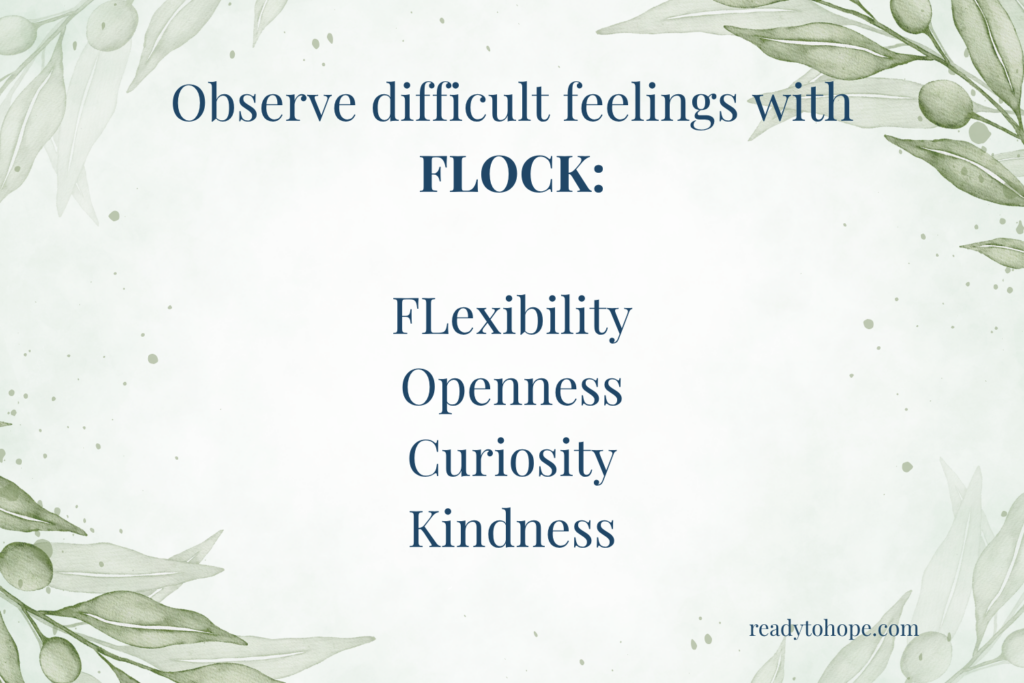
When you feel any feeling you don’t like, instead of running away, can you approach it with FLOCK!
FLOCK stands for paying attention with:
- FLexibility
- Openness
- Curiosity
- Kindness
As you can see in the FL, it’s not a perfect mnemonic but that’s okay. But it’s still a wonderful reminder to keep close. Whether it’s anxiety or another challenging emotion like sadness, stress, overwhelm, or even deeper emotions like grief, if you can sit back and observe the emotion with flexibility, openness, curiosity and kindness (to yourself), you are on the mindfulness path!
We will talk a lot about mindfulness but again- one important distinction to recognize early is the difference between mindfulness and relaxation. Relaxation is often a byproduct of mindfulness, but definitely not always and it’s definitely not the goal!
If you are being mindful in a genuinely challenging situation you will not be relaxed. Have you ever heard the phrase “slow is smooth and smooth is fast”? Essentially what it means is that, when in a stressful situation, the smartest thing to do is to slow down and be mindful in order not to make mistakes. And ultimately, often that is more effective and the job gets done quicker than if you were to give into the anxiety and make mistakes!
If you are being mindful while mourning, you will not feel relaxed. You will feel sadness, but not relaxation, and you will be present with the sadness.
If you are mindful in a sports competition, you will almost definitely not feel relaxed.
Relaxation techniques are almost the exact opposite of mindfulness techniques.
The aim of a relaxation technique is to control or alter your feelings, to get rid of the stress or anxiety and replace it with relaxation or calmness.
Whereas the goal of mindfulness is to allow your feelings to be as they are, without trying to control or alter them.
We will discuss lots of mindfulness tools along the way, but this week we wanted to share just a couple to get you started
Leaves on a stream
This is a visualization exercise to begin to learn to mindfully observe thoughts without allowing them to hook you or keep you stuck.
- Get comfortable: Sit in a relaxed, upright position with your feet flat on the floor and your hands resting easy. Close your eyes or soften your gaze toward the ground.
- Breathe and settle: Notice your breath as it moves in and out. Feel the support of the chair or floor beneath you.
- Imagine a stream: Picture yourself sitting beside a peaceful, gently flowing stream. Notice the sounds of the water, the trees, and the fresh air around you.
- Visualize leaves: Imagine leaves of different shapes, sizes, and colors floating down the surface of the stream at their own natural pace.
- Place thoughts on the leaves: As thoughts, memories, or worries enter your mind, picture placing each one onto a leaf. Let the leaf carry the thought away downstream. Do this for positive, negative, or neutral thoughts alike.
- Allow and observe: Do not try to rush the water or force the leaves to move faster. If a leaf gets stuck, let it stay stuck until it floats away on its own. If your mind wanders or you get distracted, gently bring your attention back to the stream.
Turning down the dial
This is a visualization technique used to lower the intensity of overwhelming emotions, stress, chronic pain, or racing thoughts.
Instead of trying to abruptly switch off a difficult feeling (which often causes resistance and makes it worse), you imagine a physical dial—like a volume knob or a dimmer switch—and gradually turn it down to a manageable level.
- Identify the feeling: Pause and notice what is overwhelming you right now. Is it anxiety, anger, physical tightness, or a loud internal monologue? Acknowledge its presence without judging it.
- Picture your dial: Close your eyes and visualize a dial or a slider in your mind.Assign it a number from 1 to 10 based on how intense the feeling is right now (e.g., “My anxiety is at an 8”).See the color, shape, and texture of the dial.
- Breathe and turn: As you take slow, deep breaths, imagine your hand gently gripping the dial. On every long exhale, picture yourself smoothly turning the dial down by one notch. Move from an 8 to a 7, then a 6. Feel the corresponding physical or mental sensation soften slightly with each number.
- Settle at a manageable level: You do not need to force the dial all the way to zero. The goal is simply to reduce the volume enough so you can think clearly.. You may find that a three or four feels like a major victory! You decide where you feel more mindful and present.
Box breathing
Also called square breathing, box breathing is a simple mindfulness technique that uses equal counts of inhaling, holding, and exhaling to calm your nervous system and lower stress.
Box breathing is super simple!
- You simply breathe in for four counts.
- Hold for four counts.
- Exhale for four counts.
- Hold for four counts.
- And repeat until you feel that you are in a better place to mindfully proceed!
Now, as always, let’s turn to scripture to explore what the Bible can teach us about anxiety!
For this week, we are going to look at one of my favorite ways to combine the Bible and ACT therapy: an example of Jesus as the anchor in our storm.
If you haven’t yet learned this, ACT loves metaphors for ways to illustrate and understand our feelings and emotions, and one of my favorite metaphors is the idea of a storm. If you think of your difficult emotions as a storm, swirling all around you, the goal would be that you could learn how to ground yourself, even as the storm continues to swirl. You don’t influence or stop the storm (your difficult feelings). Instead, you find a quiet, calm strength and centeredness, even as the storm continues.
So let’s read Mark 4:35-41:
Jesus Calms the Storm
35 That day when evening came, he said to his disciples, “Let us go over to the other side.” 36 Leaving the crowd behind, they took him along, just as he was, in the boat. There were also other boats with him. 37 A furious squall came up, and the waves broke over the boat, so that it was nearly swamped. 38 Jesus was in the stern, sleeping on a cushion. The disciples woke him and said to him, “Teacher, don’t you care if we drown?”
39 He got up, rebuked the wind and said to the waves, “Quiet! Be still!” Then the wind died down and it was completely calm.
40 He said to his disciples, “Why are you so afraid? Do you still have no faith?”
41 They were terrified and asked each other, “Who is this? Even the wind and the waves obey him!”
Before you read on, take a moment to meditate on those words and seek what God is trying to tell you.
Now, let’s discuss!
First: we could consider the boat in a storm as a mirror for how it feels when anxiety comes over us.
Think about how the waves crash into the boat. What feelings did the disciples have?
They were nervous, panicked, undoubtedly their nervous systems were firing like crazy!
They undoubtedly felt a lack of control over their situation. Just as the boat filling with water felt out of control, our anxiety often tries to tell us that a situation is out of control, hopeless, and we can’t get out of it or fix it, or even worse, that we won’t survive.
The disciples were reacting with frantic terror, much like the hyper-vigilance that anxiety causes. We feel like all we are doing is scanning for danger, and anxiety tells us the danger is real and it’s coming for us.
Second: we can look at how Jesus handled a situation that, for most of us, would cause stress and anxiety.
Jesus was down in the stern, sleeping on a cushion?!
What does that tell us about Jesus? He wasn’t worried. He had an internal knowing that was obviously supernatural. While there was chaos all around him, he was untroubled.
What can we learn from Jesus’ reaction?
His ability to sleep in a panic-inducing environment was the ultimate example of trust in God.
We talk about being grounded and centered even in the storm. That was Jesus.
Also, he was still present. He hadn’t abandoned the disciples. He simply wasn’t worried!
So we can think of him as the calm, safe, trusted source, whatever we may face.
What can we learn from the disciples in this situation?
Two things.
First: take your stress to Jesus.
But also: while he can handle your chaotic response, if you can work on practicing your ACT tools, your panicked response may not be necessary. Or rather: it isn’t necessary. Because Jesus can calm the storm. He’s so confident, and you can place your confidence in him so much that he can sleep, even while the storm is happening around you.
So ultimately, our goal is to learn how to calm and center ourselves, and with practice and supporting one another and holding one another accountable we will all get better at doing just that, but in the meantime, know that it is okay to take your raw, messy, chaotic feelings to Him as well!
Application:
What stresses are you currently facing, or what kinds of anxious thoughts do you struggle with?
What mindfulness practices would you like to try? This week we want to actually try them on, together!
If you’re not a part of our outpost or want to learn more, email us here! Or just reach out with any questions you might have, we’d love to hear from you!