

Week Nine in Renewing Our Minds
Do not conform to the pattern of this world, but be transformed by the renewing of your mind. Then you will be able to test and approve what God’s will is—his good, pleasing and perfect will. Romans 12:2
After eight weeks of studying how we can use a combination of ACT therapy plus leaning on scripture and our faith practices, this week we are going to begin to make it practical!
To refresh your memory, one of the main underlying concepts driving this entire study is that God created our brains in such a way that we can create new neural pathways.
So not only does science (or neuroscience) support this idea in practice, but we know that this is how God wired us!
Whatever you have been through, whatever mental habits you have created, whatever you are going through- God made you so that you can change! You can choose new habits, practice new ways of thinking, and in so doing, find yourself living a more fulfilling, purpose-driven, and joyful life.
How wonderful and hopeful is that?
While you can go back and read any of the previous posts to learn more about how we have addressed certain issues, from anxiety to despair to challenging people, today we are going to let you choose what you want to work on, and put it into practice!
Let’s start with what we know about ACT so far
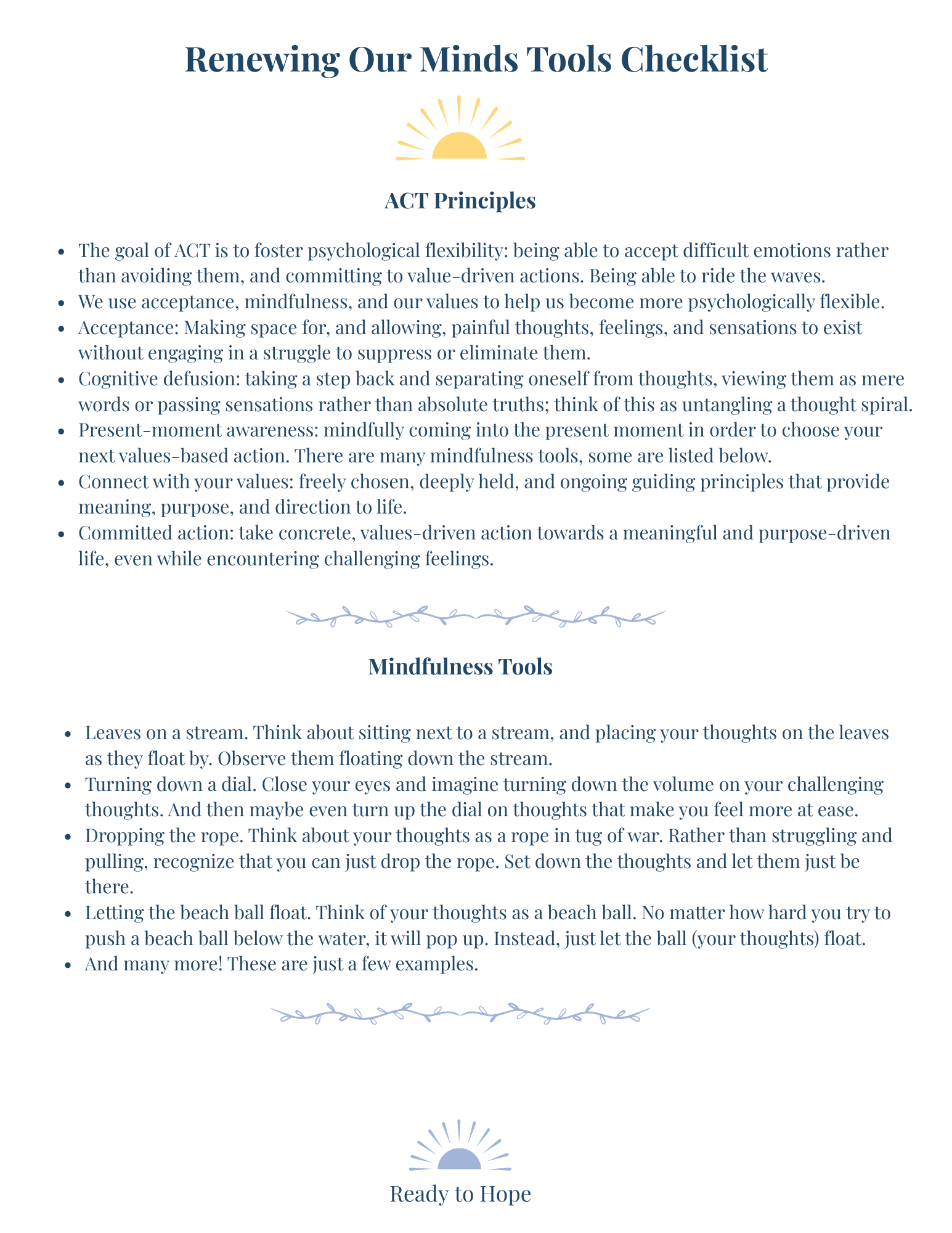
The goal of ACT is to foster psychological flexibility
We touched on this last week but this is a great way to distill down what we are working to achieve with ACT therapy.
We can think of psychological flexibility as being able to accept difficult emotions rather than avoiding them, and committing to value-driven actions.
So, instead of trying to eliminate negative thoughts, ACT teaches individuals to observe them without judgment (mindfulness) and then we can defuse (untangle) from them, and reduce their power.
We use acceptance, mindfulness, and our values to help us become more psychologically flexible.
As we’ve talked about repeatedly, acceptance is the first part of ACT because the number one thing that we are working to do is to drop the struggle with our challenging feelings.
So often in therapy (or in life!) we want to just get the difficult feelings to stop.
What we’ve learned from ACT is that avoiding or running away from or distracting ourselves from or even self-medicating through food, alcohol, or social media never actually solves anything. When we return to ourselves, the issues are still there.
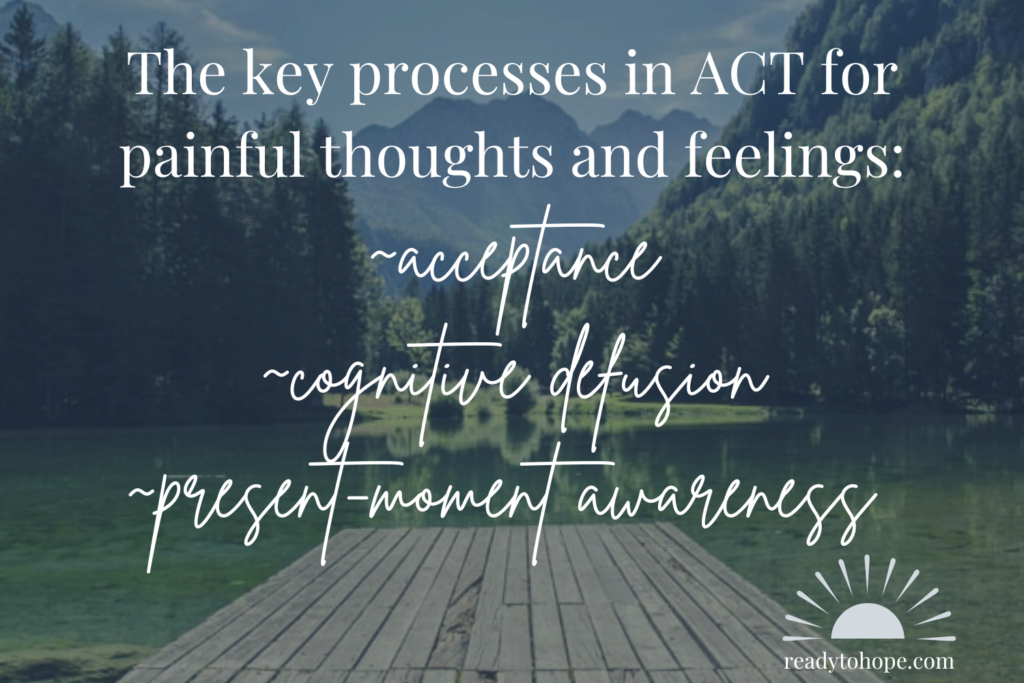
So let’s summarize the key processes in ACT for painful thoughts and feelings:
Acceptance
Making space for, and allowing, painful thoughts, feelings, and sensations to exist without engaging in a struggle to suppress or eliminate them.
Cognitive defusion
Taking a step back and separating oneself from thoughts, viewing them as mere words or passing sensations rather than absolute truths (e.g., singing a negative thought, saying “I am having the thought that…”). Think of this as untangling a thought spiral.
Present-moment mindfulness
Now that you have a little distance from your thoughts, come into the present moment. By grounding yourself in the moment, you may even be able to adopt a curious stance towards your thoughts.
Mindfulness tools you can try to help you make room for your thoughts and even let them go:
- Leaves on a stream. Think about sitting next to a stream, and placing your thoughts on the leaves as they float by. Observe them floating down the stream.
- Turning down a dial. Close your eyes and imagine turning down the volume on your challenging thoughts. And then maybe even turn up the dial on thoughts that make you feel more at ease.
- Dropping the rope. Think about your thoughts as a rope in tug of war. Rather than struggling and pulling, recognize that you can just drop the rope. Set down the thoughts and let them just be there.
- Letting the beach ball float. Think of your thoughts as a beach ball. No matter how hard you try to push a beach ball below the water, it will pop up. Instead, just let the ball (your thoughts) float.
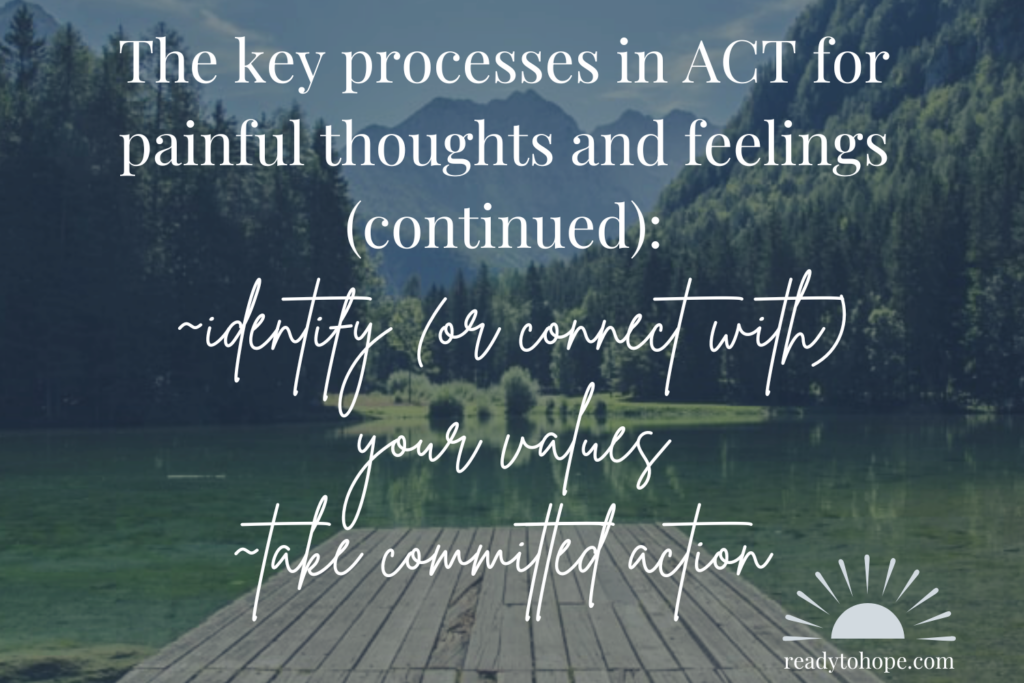
Identify your values
Hopefully once you make space for your challenging thoughts and feelings, and then practice mindfulness, you now are feeling a little more capable of thinking about your values.
With a little more psychological space and flexibility, you can reconnect to your values.
We’ve talked at length about values but if you still need to spend some time gaining clarity on yours, here is a link to a PDF to do so!
A couple of questions to help you remember what matters most to you might be:
- How do you want to make people feel?
- What do you want people to say about you?
- What do you want to be remembered for?
- What are the things that keep you up at night, wishing you could impact them?
Ideally you are able to come up with three to five core values! And once you do, you can take action, below!
Committed action
You haven’t fixed the feelings, right? That’s okay. Your goal isn’t to run away from the feelings. Your goal is to move into a psychologically flexible space where you can still act and move forward, according to your values, in order to achieve the things in your life you desire to achieve.
So now, with your values front and center, take a committed action!
Now, as always, let’s turn to scripture!
Our goal this week is that you would begin to make this study your own. Each week we have spent time in the word as a tool to study what the scriptures say about various feelings and experiences.
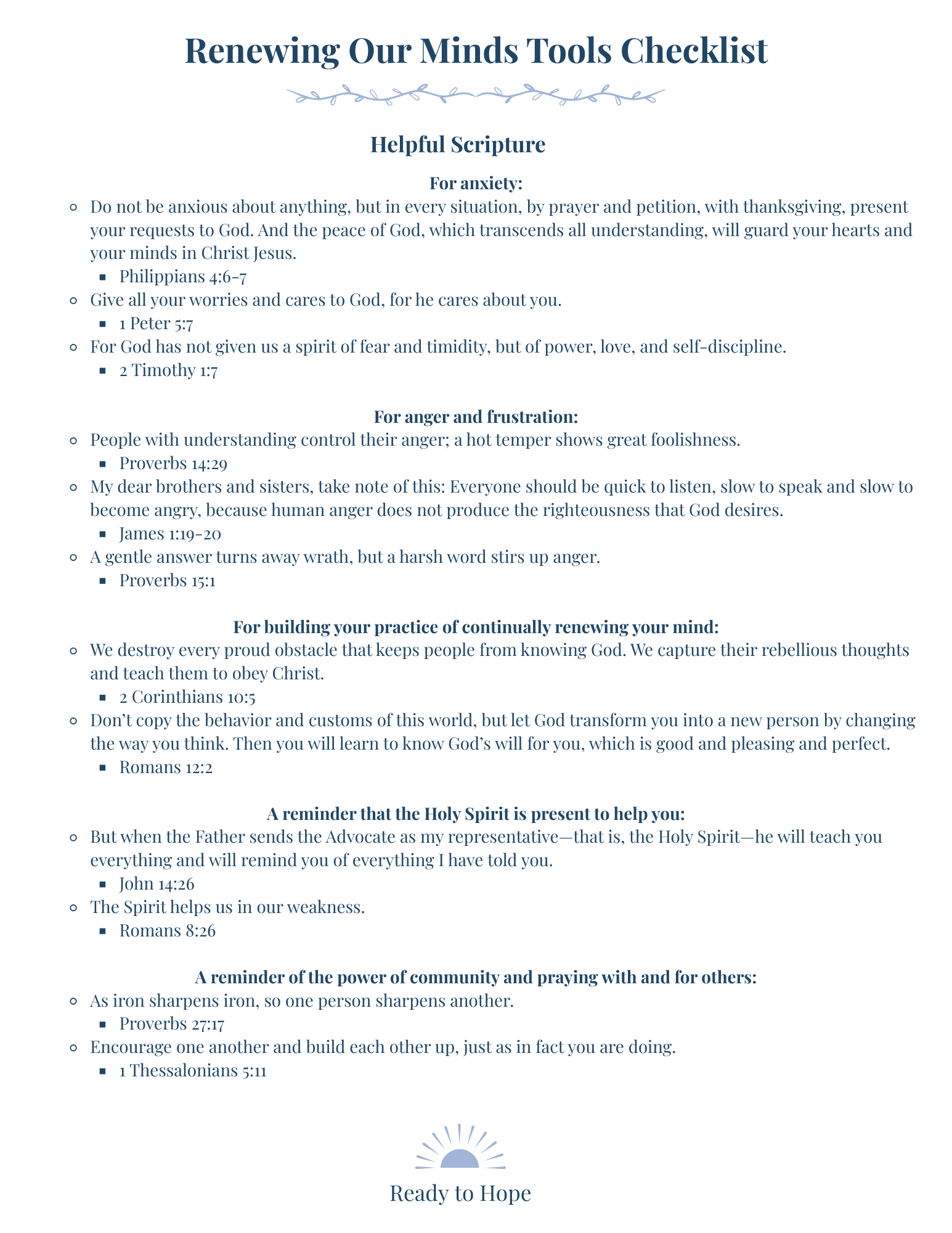
Today we want to let you explore what verses resonate most with you, and that you might want to add to your spiritual toolbox!
Our goal for today is to share a few verses that you may find helpful, but as you know, the Holy Spirit speaks to us in our own unique ways, so please know that, just like growing your mental health toolbox, discovering scripture that speaks to you may be a work in progress!
A few to consider include:
For anxiety:
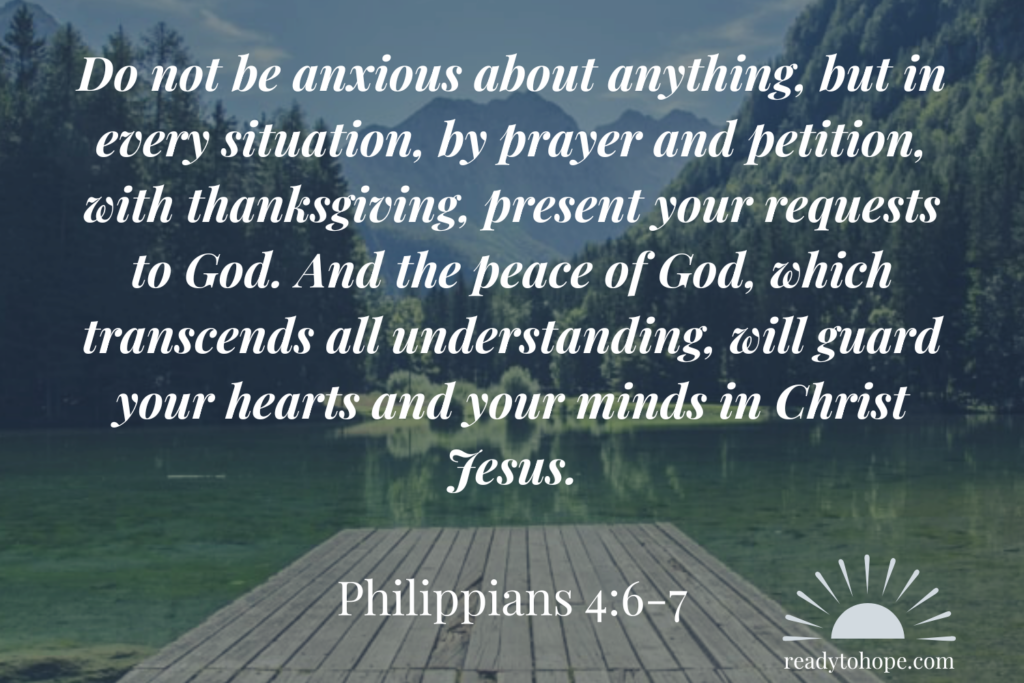
Do not be anxious about anything, but in every situation, by prayer and petition, with thanksgiving, present your requests to God. And the peace of God, which transcends all understanding, will guard your hearts and your minds in Christ Jesus.
Philippians 4:6-7
Give all your worries and cares to God, for he cares about you.
1 Peter 5:7
For God has not given us a spirit of fear and timidity, but of power, love, and self-discipline.
2 Timothy 1:7
For anger and frustration:
People with understanding control their anger;
a hot temper shows great foolishness.
Proverbs 14:29
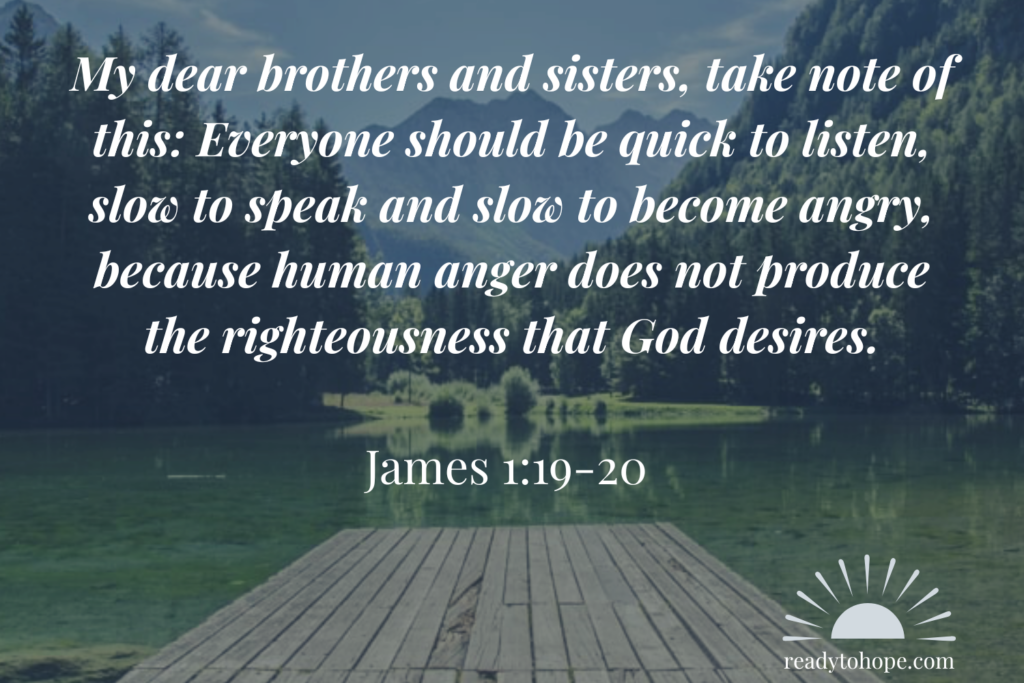
My dear brothers and sisters, take note of this: Everyone should be quick to listen, slow to speak and slow to become angry, because human anger does not produce the righteousness that God desires.
James 1:19-20
A gentle answer turns away wrath, but a harsh word stirs up anger.
Proverbs 15:1
For building your practice of continually renewing your mind:
We destroy every proud obstacle that keeps people from knowing God. We capture their rebellious thoughts and teach them to obey Christ.
2 Corinthians 10:5
Don’t copy the behavior and customs of this world, but let God transform you into a new person by changing the way you think. Then you will learn to know God’s will for you, which is good and pleasing and perfect.
Romans 12:2

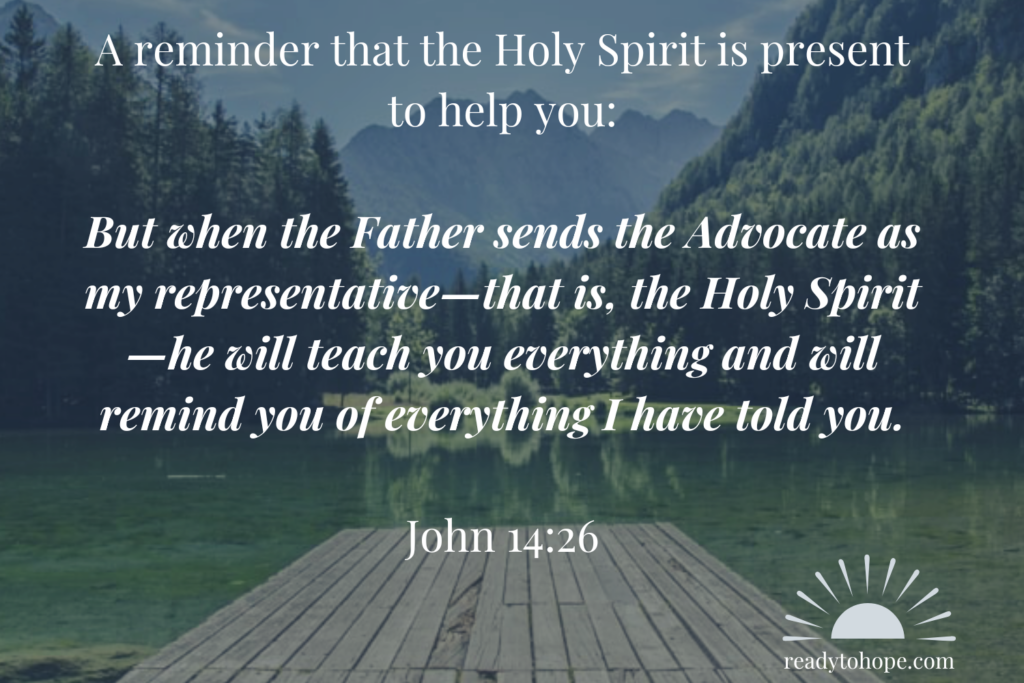
A reminder that the Holy Spirit is present to help you:
But when the Father sends the Advocate as my representative—that is, the Holy Spirit—he will teach you everything and will remind you of everything I have told you.
John 14:26
The Spirit helps us in our weakness.
Romans 8:26
A reminder of the power of community and praying with and for others:
As iron sharpens iron, so one person sharpens another.
Proverbs 27:17
Encourage one another and build each other up, just as in fact you are doing.
1 Thessalonians 5:11
Which verses speak to you? Which will you begin to try out the next time you are experiencing challenging thoughts and feelings?
Below we have a link for a PDF that you can keep on hand- over the next couple of weeks, try practicing these ACT tools, then choosing a favorite verse, and just notice and observe how the practice makes you feel!
And as always, if you’d like to connect with us for questions or prayer, reach out here!