

Week Eight in Renewing Our Minds

As we have examined the idea of Renewing Our Minds for these several weeks and months, we have come quite a long way!
Using Romans 12:2 as our initial inspiration, then leaning on scripture, Acceptance and Commitment Therapy (ACT), and borrowing some wisdom from Every Thought Captive by Kyle Idleman, we have established a strong foundation.
We know now that our thoughts influence our feelings and our feelings influence our actions.

We have learned a number of ACT principles to help us begin to make space for the truth that life can be challenging, but armed with the right tools, with our faith in God’s provision, and with a loving, like-minded community, we have the ability to face life’s challenges with presence, patience, and purpose.
All along we have talked about hard feelings like sadness, disappointment, and frustration.
Today we are going to do a deeper dive into true depression and even despair.
In other words: what do you do when you are very low?
Whether it is situational and you know it will pass, or you know that you are truly depressed and struggling longer term, there are tools and scriptures you can learn to lean on that can bring you not just relief, but also hope!
Let’s dive in!
First, it might be helpful to know how we’re going to approach today’s study:
We will first talk about ACT therapy and some of the tools it offers to manage challenging feelings and depression.
We will then look at stories of despair and depression in scripture.

The important first step in ACT therapy for depression is Acceptance
It’s in the title of the therapy, and it’s never more important than when we approach really painful, challenging feelings- acceptance.
Since we’ve talked about acceptance a lot during our time together, and you can go back and check out any of the older posts, we thought that today we’d spend a little time diving a little deeper into the stages of acceptance.
Without a strong understanding of ACT therapy and how powerful it can be, the idea of accepting your depression or your difficult situation can almost seem counterintuitive- and that’s why we want to spend a little extra time on it today.
First, the foundational ideas behind ACT therapy are:
- Accept the feelings you are feeling, or the situation you find yourself in.
- Ground yourself with mindfulness. Come into the present moment, in order to be in a position to more deliberately choose your next action.
- And then: act according to your values.

Because we have discussed ACT so much here, we will just go with a foundational, high-level summary here, but as always, you can learn more by looking back on older posts or HERE for a summary.
Now let’s do a deeper dive into that first step: acceptance.
One important consideration about ACT therapy is its constant interplay with compassion, and especially self-compassion.
Accepting the challenges you are facing can be difficult if you resist because you struggle with the idea you “should” be a different way. Many who struggle with depression only add to their struggles because they feel like they should be able to beat it. They often feel like if only they were stronger, or better equipped, or more like other people (which we know is a silly argument since we often have no idea what others are dealing with) then they wouldn’t have to deal with depression.
This is where self-compassion is essential!
We can discuss at length what self-compassion means but the simplest definition is: treat yourself with the same kindness and gentleness that you would your best friend, or any loved one.
So many of us, especially those with depression, are kind to others but speak to themselves in ways that they would never speak to others!
Before you can accept the challenges you face, it often is helpful to make a conscious decision to be kind and self-compassionate with yourself.
With that as the groundwork, we can explore acceptance even a bit more than we have so far.
A helpful way to think about acceptance is to consider that there are steps you can take towards it.
Acceptance really has four steps:
Acknowledging
When it can be difficult to accept your situation or feelings, a good place to start is simply acknowledging them.
Think of this as naming your situation or feelings.
“I am noticing that…”
“I am having the thought that…”
“I am feeling a flood of memories from…”
Allowing
After you acknowledge your feelings or situation, you can then allow it to be what it is.
Allow those thoughts and feelings to be present.
Normalize and validate your thoughts and feelings. Perhaps you may say something like, “given what I’ve been through, it makes sense that I’d be feeling this right now.”
You can still recognize that you don’t want the feelings and thoughts to be present, but you are allowing them to happen rather than fighting them.

Accommodating
Accommodating your thoughts and feelings is going beyond allowing them, and making room for them.
Think about a house guest you aren’t excited to have staying with you! Just like your thoughts and feelings, you can recognize you may not want them here right now, but you can still help make a space for them to exist.
Accommodating can be thought of as expanding, making room, or making space.
And then, much like an unwanted houseguest, you can consider the idea of letting them come and stay and go in their own good time rather than trying to get them to go away.
Appreciating
The fourth step in acceptance is appreciating your difficult thoughts and feelings.
Again, as with so much of ACT, it feels counterintuitive, but once you embrace it, it is transformative!
When it comes to appreciating your difficult thoughts and feelings, the underlying idea that may help you is:
“These thoughts and feelings exist to teach me something. I am doing good work to move through this experience, and I can allow and accommodate and even appreciate that I will find myself in a different place with a new set of skills and experiences because of them.”
Other ways to appreciate your difficult thoughts and emotions:
“I know that God has put me in this position to grow me.”
“As I get stronger through this experience, I will be better equipped to help others in similar situations.”
And finally, you can appreciate that perhaps God has you in this season to get you to respond a certain way.
- Depression and sadness can teach us to slow down.
- Anxiety can teach us to engage with and practice mindfulness
- All of these can teach us compassion for those who go through something similar.
In ACT, the first step is acceptance, followed by mindfulness and taking values-based action. Again, throughout our studies here, we have discussed VALUES and values-based action, so please know you can check out many previous posts for more info. For today, we are going to move on now to how David handled difficult feelings and thoughts.
Paul in 2 Corinthians 1:3-11
First, spend a few minutes reading the scripture, making note of whatever you feel God is wanting you to pay special attention to. After that, continue reading!
What can we learn from Paul’s words that can help us understand our own struggles and even help us in the moment?
Paul honestly acknowledges his pain- and then chooses his values-based action.
In verse 8, Paul says, “We were crushed and overwhelmed beyond our ability to endure, and we thought we would never live through it.”
As we’ve discussed already, sometimes in our deepest pain we can see God’s plan. Intense suffering is often intended to stop self-reliance and build trust in God. Paul’s despair was a way to experience God’s resurrection power, not just know it intellectually.

Paul’s values-based action: rely on God.
Paul says that they “expected to die. But as a result, we stopped relying on ourselves and learned to rely only on God.”
Paul knows, as we do, the power that God has to bring us through difficult times, and also the peace that we can feel when we choose to turn our powerless into reliance on Him.
So, as with ACT therapy, the goal is not the removal of the pain, but the shifting into acceptance and mindfully making the choice to trust- choosing this based upon your values, which include your faith in “God, who raises the dead.”

Paul encourages community when facing hard times.
This step may be a little more Ready to Hope than ACT, but that’s more than okay!
Our mission is to build a community that cares for one another, and to help our members realize that they are never alone, and that the power of relationships can uplift and even heal.
And that’s what Paul says in verses 7 and 11!
In verse 7 he says, “We are confident that as you share in our sufferings, you will also share in the comfort God gives us.”
Essentially he is recognizing that when we care for one another in hard times, those who are doing the caring and those who are being cared for both benefit!
And then in verse 11 he speaks about the power of praying together and for one another.
“And you are helping us by praying for us. Then many people will give thanks because God has graciously answered so many prayers for our safety.”
Paul explicitly mentions the need for others to help through prayer, and even goes so far as to indicate the promise of hope. He recognizes that sharing burdens helps to lighten the load!
Jesus in the Garden, Matthew 26:36-46
Once again, go and read the scripture first! Spend a couple of minutes teasing out what you feel God wants to tell you, especially what we can learn from Jesus about suffering and despair. Then, read on!
In the Garden of Gethsemane, Jesus faced a “crushing” weight of sorrow and distress that provides a profound model for navigating our own darkest moments.
His experience shows that despair is not a sign of failure but a deeply human struggle that can be transformed through specific spiritual and emotional practices. Once again he shows his human emotions so that we can learn from him about our own faith.
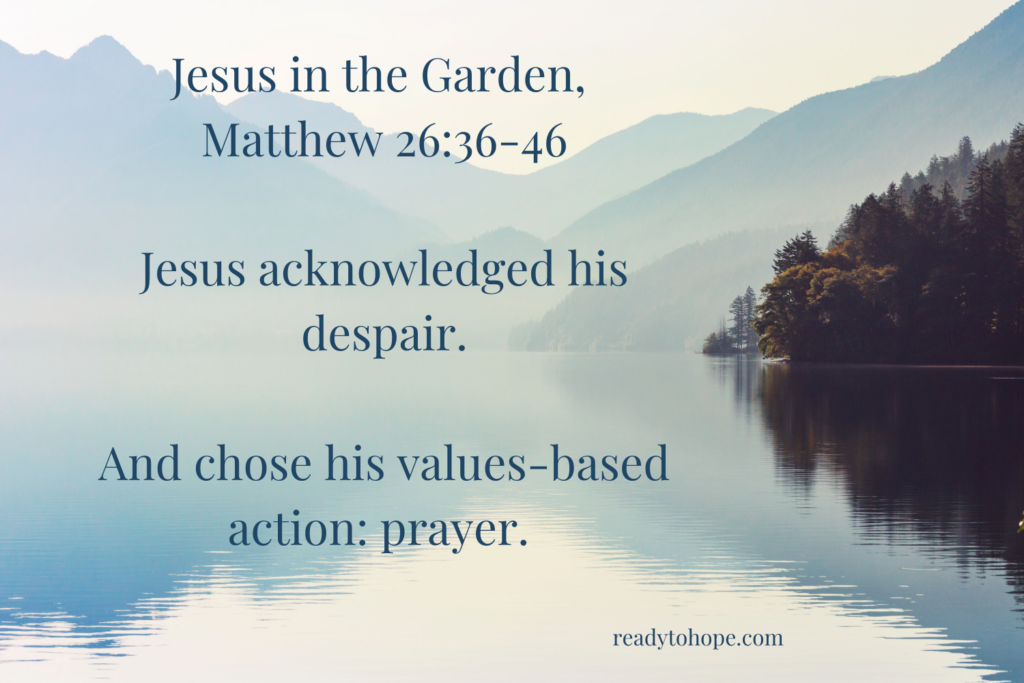
Jesus acknowledged his despair.
He didn’t hide his pain, nor did he act as though he should have it all figured out! He told his closest friends that his soul was “crushed with grief to the point of death.”
And then he chose his values-based action: prayer.
“He went on a little farther and bowed with his face to the ground, praying, ‘My Father! If it is possible, let this cup of suffering be taken away from me. Yet I want your will to be done, not mine.’”
He told God exactly how he felt, without filtering the fear or the pain.
He even asked for relief! He asked God that if it was at all possible for him to not have to endure the pain, that God would take it from him.
But then, again according to his values, he chose trust.
He prayed for relief from the pain, but trusted God’s greater purpose. What an incredible example of being honest with God about not liking your situation (acknowledging it, even if you don’t like it), but making room for it (allowing it).
And we could even say that Jesus expresses appreciation for his suffering, because he recognizes that God’s plan is greater- even when it feels like something we’d escape if we could.
Jesus also asks for help from others.
Did they fall asleep? Yes. People will not always support us in the exact way we want or need, but Jesus still models how important it is to ask others to pray for you and support you.
Finally, Jesus takes the next faithful step.
While we may not like it in the moment, and Jesus certainly didn’t like it in the moment, we know that he chose to tell his disciples, “Up, let’s be going. Look, my betrayer is here!”
In ACT therapy the “commitment” is as important as the acceptance. Making peace with your situation, accepting it, turning it over to God, praying over it, all of these are just as important as then committing to your values-based actions and taking the next step forward towards your values-based, rich and meaningful, purpose-based life.
What else do you find meaningful in these verses? What will you take away from this study time? What tools and scripture will you hold close to your heart for the next time you find yourself in a place of deep sadness?
As always, we want to support you in any way that we can! You can message us here to find out more about our Ready to Hope outpost at Mercy Road church!