
Renewing Our Minds, Bodies, and Spirits: Introduction
The Ready to Hope outpost was originally created to be a space to grow in your faith, put some roots down with a young adult community, and also to have a place to process the emotions we all deal with that sometimes challenge us.
As a faith-led community, we know that life can be challenging, and while our faith practices help us so much to find peace and presence, sometimes we need more.
Acceptance and Commitment Therapy is the “more” for our outpost. The concepts, tools, and resources available from this way of looking at mental health have proven to be easy to understand and apply, and have helped so many of us in the past year.
Last year our study was all about taking our thoughts captive and renewing our mind, turning to God and letting Him help guide our thoughts, and learning to trust His will for our life.
This year will look a lot like last year, but we are going to focus this year not only renewing our minds- taking our thoughts captive- but also on how we care for our body and spirit.
Last year we had Romans 12:2 as our guiding scripture, this year we are simply going to add Romans 12:1.
Therefore, I urge you, brothers and sisters, in view of God’s mercy, to offer your bodies as a living sacrifice, holy and pleasing to God—this is your true and proper worship. Do not conform to the pattern of this world, but be transformed by the renewing of your mind. Then you will be able to test and approve what God’s will is—his good, pleasing and perfect will.
This year, we are going to take all we learned from last year, and layer on even more wisdom and opportunities to grow stronger in our faith, stronger as a community, and stronger in how we care for our minds, bodies, and spirits.
First let’s look at how our faith and mental wellness intersect in a truly wonderful way!
A truth that you maybe haven’t considered before, but once you grasp, will likely change how you approach caring for your own well-being:
Your thoughts create your emotions. And your actions often stem from your emotions.
So sometimes we get swept along by our emotions- but we have the ability to change the thought that happens first!
With practice, you can learn to take your thoughts captive. You can continually renew your mind.
Scripture has been pointing to this for years, right?
Well, now science is catching up with what we’ve been reading in our Bibles!
Neuroplasticity is the scientifically proven term behind your brain’s ability to change.
Did you catch that? God made your brain with the ability to change!
Not only does scripture encourage us to continually renew our minds in order to let God guide our choices and decisions and actions, but science now has a term for it: neuroplasticity.
With time and practice and repetition, you can actually change the way your brain is wired!
Instead of often getting stuck in a thought pattern, you can- with time and practice- lay down a new pattern!
Neuroplasticity is God-given and a blessing from Him!
Rest in that truth, let it soak in. And lean on it when you want to make a change!
Now let’s briefly look at what Acceptance and Commitment Therapy is all about.
The main goal of Acceptance and Commitment Therapy is psychological flexibility.
It’s so helpful to understand this! While we have many tools and resources and ideas and concepts we will study, it all comes down to this goal:
When you face hard moments, the more you are able to ride the waves, the less you will struggle.
ACT therapy (or ACT, we will use both interchangeably) is all about learning how to ride the waves of our emotions, rather than getting stuck in them.
There are three main steps in ACT therapy.
First: acceptance.
Life is challenging. We all face challenges every single day. From simple “nuisance” stressors like traffic or forgetting to take your lunch to work, all the way to a clinical diagnosis of anxiety or depression- we want to recognize that life can be challenging.
And the biggest source of psychological suffering is the idea that we need to make the challenge go away.
Running away from a problem has never solved a problem! You can try to stop being sad through “healthy” tools like calling a friend, going for a walk, or listening to music. Or you can try to stop being sad through unhealthy coping mechanisms like turning to drugs or alcohol, overeating, or binging Netflix.
But all that does is push the sadness away for a bit. It doesn’t actually change your situation.
Acceptance is the idea of choosing not to try to run away from our difficult feelings, but instead recognizing that life can be hard. If you’re alive, you’ll face hard times. And choosing to accept that paves the way for the next steps.
(Just a note- acceptance takes work. It’s not as simple as saying “I accept this.” We’ll talk about the many ways you can work on it in the weeks to come!)
Next: mindfulness
Once you have chosen not to run away from your difficult feelings, the next step is mindfulness, which is simply the act of becoming grounded and centered.
There are many ways to become grounded and centered, and we will talk about them in the weeks to come, but the goal in getting centered is that you put yourself in a position to make a values-based decision.
Instead of being reactive when you feel overwhelmed, stressed, angry, frustrated, sad, or any of the human emotions we all experience, you can be purposeful. You are able to choose your next action in a way that will make you feel proud of yourself.
And finally: taking a committed action
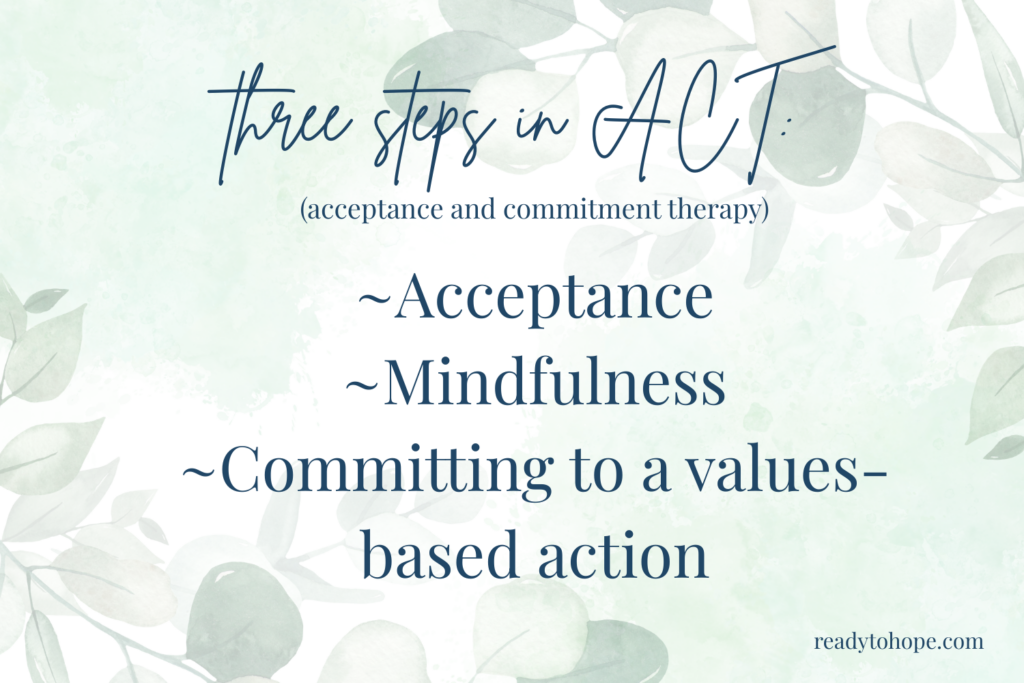
The commitment part of ACT therapy is forward motion.
Life is challenging. But when you are able to accept that truth, and then get yourself grounded and centered through whatever mindfulness practices you find most helpful, you can then make a decision to take action, according to your values.
Life will always dish out challenges- the goal is to be able to ride the waves of the emotions that come with those challenges, so that you can keep moving forward towards a life that feels meaningful to you.
With the right tools and support- and a lot of repetition- ACT therapy can help you live a purpose-filled life, despite the challenges that will inevitably keep coming your way. And mine too. And everyone else’s, too!
Now let’s look at scripture that we can lean on and turn to this year!
For some lessons, we will look at passages and stories in the Bible.
However, for this week, we are going to begin by looking at what we want to make our guiding verses for this entire year.
We still want to spend some time considering what God is telling us as we read these verses, however!
Here are your verses:
“Therefore, I urge you, brothers and sisters, in view of God’s mercy, to offer your bodies as a living sacrifice, holy and pleasing to God—this is your true and proper worship. Do not conform to the pattern of this world, but be transformed by the renewing of your mind. Then you will be able to test and approve what God’s will is—his good, pleasing and perfect will.”
~Romans 12:1-2
“So we do not lose heart. Though our outer self is wasting away, our inner self is being renewed day by day.”
~2 Corinthians 4:16
“And to be renewed in the spirit of your minds.”
~Ephesians 4:23
“Finally, brothers, whatever is true, whatever is honorable, whatever is just, whatever is pure, whatever is lovely, whatever is commendable… think about these things.”
~Philippians 4:8
“Set your minds on things that are above, not on things that are on earth.”
~Colossians 3:2
How will this year look different than last year?
First: we are going to emphasize the idea of continually renewing.
To change our thought habits, we have to put in time and effort!
Changing your thought habits is no different than changing your body when you want to get stronger. One workout doesn’t make much of a difference. Even ten workouts won’t make a dramatic difference! But by the time you do twenty workouts, you start to really feel different, right?
It is the same with your thought habits. So we will do lots of reps and sets!
Repetition is the goal. The more you practice, the more you talk about and listen to and implement the tools, the better! Continually renewing.
Second: we are going to look not just at common mental and emotional challenges, but also how we care for our bodies via nutrition, fitness, and rest.
Finally: we are going to work to have a practical application action step each week. This may be an activity we do during outpost, or it may involve work you do between outpost meetings, but we want to do our best to put the concepts into action each week! Continually renewing!
Application:
To begin this year with intention, we want to look at where we most want to see change.
When you know where you want to go, it can be easier to create your path to get there, right?
Your assignment will be the following:
Part One:
Spend five minutes and journal or write or think or pray (whatever method you like best!) on the area of your life you’d most like to see change.
Everyone has things they are dealing with, so this is a time for you to begin thinking about yours.
We will have a chance to share, but you always have the option of choosing not to share. This group is about being transparent so that we can support one another, but feeling safe and comfortable to share takes time, so if you’re not there yet, that’s okay. Still take the time to do the exercise for your own personal growth.
If you’re not sure where to start or what you’d most like to work on, you might try asking yourself this question: if I could pray to God to change something in your life and know He would answer instantly and completely, what would you ask for first?
Other questions to consider:
- What keeps you up at night?
- What do you keep saying you want to change and keep feeling frustrated you can’t seem to change?
- What keeps you from feeling like you are living your best life?
Part Two:
Over the next couple of weeks, your goal is to simply recognize when you feel stuck on this issue.
The first step of acceptance is acknowledging. We will talk about the other steps in weeks to come, but for now your goal is to just notice.
Please know this: even just noticing is gaining just a little bit of distance from those challenging thoughts and feelings. So just that one small step is a step in the right direction to gaining psychological flexibility!
And finally:
Work on your memory verses! Start with your favorite (or the shortest) and see if you can begin to commit it to memory!
As always, we welcome your questions, comments, feedback, or even just reach out if you need some support! You can email us here!