

Week Eleven in Renewing Our Minds
Our Renewing Our Minds study has been a journey! In these weeks together you have learned so much about how your thoughts create your emotions, and that when you are purposeful about your thoughts, you can actually change your emotions- and your behaviors!
We have also explored a number of common mental and emotional challenges that we all face, from insecurity to anxiety, depression, and anger.
And in the past couple of sessions, we’ve begun to look at some practices that we can implement to truly take control of our thoughts and keep our eyes fixed on Jesus.
Last week we discussed how, with practice, we can learn to view the world through a godly lens. Check out that post here!
Today, armed with the knowledge that we have the ability to choose our perspective, we are going to practice some valuable tools. By implementing tools we can build new mental and spiritual pathways to help us stay more focused on the godly lens, more of the time.
Repetition helps create new mental pathways
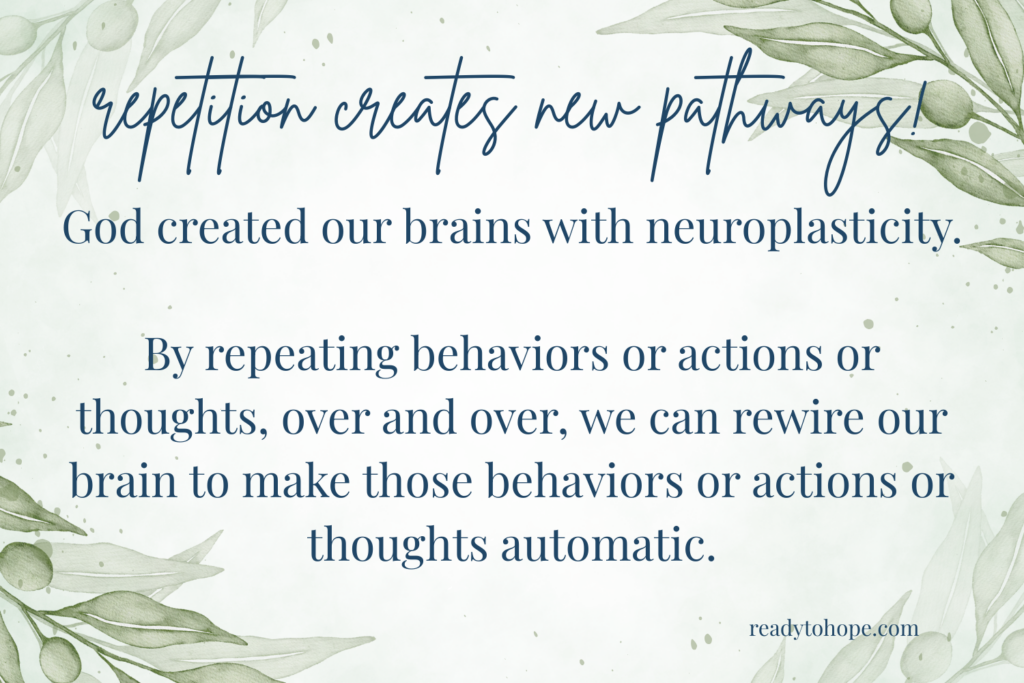
If you go back to the very first lesson in this study, we talked about how God created our brains with neuroplasticity, which is a fancy term to say that our brains can change!
By repeating behaviors or actions or thoughts, over and over, we can rewire our brain to make those behaviors or actions or thoughts automatic.
Science supports this concept, so you can feel confident that if you are willing to put in the time and effort, you can actually teach your brain to naturally gravitate to the godly lens.
And since we are always seeking to make you feel capable and empowered, here is a truth you should know: it will take a lot of repetition.
There are studies that show that it can take more than 300 reps to create that change.
Before you are discouraged however, think about it this way: if you wanted to get stronger, you would never assume that you only need to go to the gym three or four times, right? No, you would know before you even begin that it will take time and consistency.
And shifting your lens will be no different.
We are going to use the power of affirmations- that you actually believe!
As we have discussed in the past, affirmations can be a powerful tool for change, but they only work if you actually believe them.
In other words, you can’t tell yourself “I am a brilliant chemistry student,” and suddenly become great at chemistry if you’ve never studied chemistry and find it challenging.
But if you truly believe the affirmation, “I am a child of God and am loved for who I am,” and you repeat that over and over again, it becomes part of how your brain is wired to think.
Repeating affirmations that you truly believe makes them more automatic when you need them.
Words matter. The messages you send yourself matter. And you can choose words that empower your walk with Jesus.
Let’s explore the power of words in scripture
The tongue has the power of life and death, and those who love it will eat its fruit.
Proverbs 18:21
Here the psalmist declares that the tongue has the power of life and death! The fruit of your words can be positive and uplifting, or it can break others (and yourself down).
The mouth of the righteous is a fountain of life,
but the mouth of the wicked conceals violence.
Proverbs 10:11
The words of the reckless pierce like swords,
but the tongue of the wise brings healing.
Proverbs 12:18
Let’s spend a few minutes applying these verses to our own lives.
As you create your affirmations, it can be incredibly helpful to think about how words have built you up in the past, but also how they have hurt you and broken you down.
So, consider the following:
What are some of the words you’ve been told that have hurt you deeply?
Maybe a parent, or a teacher, a coach or a boss said something that really stung. It may have been true but not what you wanted to hear. It may have been honest feedback delivered in a horrible way. Or it may have been simply mean.
Most of us can easily recall being deeply hurt by words.
While this can be a painful exercise, it certainly illustrates- words have power.
What are the most wonderful things that have been spoken to you? The things you remember and hang on to?
It has been said that most of us more easily remember criticism than positive feedback, but hopefully you have a few of those nuggets.
What are the most wonderful compliments you’ve been given?
They’re likely not about your outfit or your car, right? They likely speak to your deepest desires for the type of person you want to be.
Being told that you are kind, or thoughtful, or compassionate, or a gifted (fill in the blank) goes a long way to helping not just build you up but to affirm how you are presenting yourself to the world- and make you want to do more of that.
Words have power.
As the rain and the snow
come down from heaven,
and do not return to it
without watering the earth
and making it bud and flourish,
so that it yields seed for the sower and bread for the eater,
so is my word that goes out from my mouth:
It will not return to me empty,
but will accomplish what I desire
and achieve the purpose for which I sent it.
Isaiah 55:10-11
The words that you speak, to yourself and to others, will achieve the purpose for which you sent them!
If you choose words that break down your faith and your strength, they will achieve that purpose.
If you choose words that remind you of the goodness of God and his unending grace and love for you, they will achieve that purpose and you will find it easier to choose the godly lens.
Do not let any unwholesome talk come out of your mouths, but only what is helpful for building others up according to their needs, that it may benefit those who listen.
Ephesians 4:29

Your affirmations should build you up, according to your needs, so that they will benefit your own brain, which is constantly listening to the messages you send yourself.
Now let’s create your affirmations!
You are going to use the tools that you have learned in the past ten weeks to create five to ten affirmations.
First, to help you recall all that we have discussed, here is a brief summary of Acceptance and Commitment Therapy:
- Your thoughts create your emotions, and your emotions often influence the behaviors and actions you choose- and you can, with practice and purpose, choose thoughts that serve your goals for your life.
- Cognitive fusion is a state where you find yourself stuck in a thought spiral. Sometimes we get fused with our strongholds. Our strongholds are the lies we tell ourselves that are often rooted in hurts we have experienced.
- Acceptance is a tool we use to defuse, or get out of a state of cognitive fusion. Acceptance doesn’t mean that we like the situation or challenge we are in, but it means that we accept it for what it is, in order to drop the struggle. Much of psychological and spiritual pain is a result of wanting things to be different than they are.
- When we practice the challenging but helpful tool of acceptance, we can drop the struggle. We can use mindfulness tools to come into the present moment.
- When we are more grounded and centered, we may still not like our situation, but we have the ability to still stand up and move forward towards our values. We can choose a values-based action, even in the midst of challenges.
- All of these tools lead to psychological flexibility, which is the ultimate goal of ACT therapy: to be able to handle the highs and lows, the ebbs and flows, of life and to ride the waves without getting stuck, so that you can keep moving forward and living a life of purpose based upon your chosen values.
And second, scripture we have referred to over and over:
- “ Do not conform to the pattern of this world, but be transformed by the renewing of your mind. Then you will be able to test and approve what God’s will is—his good, pleasing and perfect will.”
- Romans 12:2
- Above all else, guard your heart, for everything you do flows from it.
- Proverbs 4:23
- The Mary vs Martha story in Luke 10:38-42. When Jesus visited Mary and Martha, Mary sat at his feet because she wanted to be close to him and learn from him. Martha was busy cleaning and preparing food and was frustrated with Mary.
- We can use Mary’s example as a tool and a reminder of a way to defuse, to drop the struggle and just be with Jesus, to be mindful in the moment of God’s presence.
- Finally, brothers and sisters, whatever is true, whatever is noble, whatever is right, whatever is pure, whatever is lovely, whatever is admirable—if anything is excellent or praiseworthy—think about such things.
- Philippians 4:8
- Can be used as a filter, a reminder for how we want to focus our energy and our heart and our eyes.
- For we speak as messengers approved by God to be entrusted with the Good News. Our purpose is to please God, not people. He alone examines the motives of our hearts.
- 1 Thessalonians 2:4
- Helpful when we struggle with comparison and insecurity
- And the Holy Spirit helps us in our weakness. For example, we don’t know what God wants us to pray for. But the Holy Spirit prays for us with groanings that cannot be expressed in words.
- Romans 8:26
- A simple reminder that the Holy Spirit is always there, our helper and our support as followers of Jesus.
Now, hopefully with your memory jogged from our past sessions, you can create some affirmations that you want to use to retrain your brain with scripture and truths that you want to make a part of your daily and even hourly thinking!
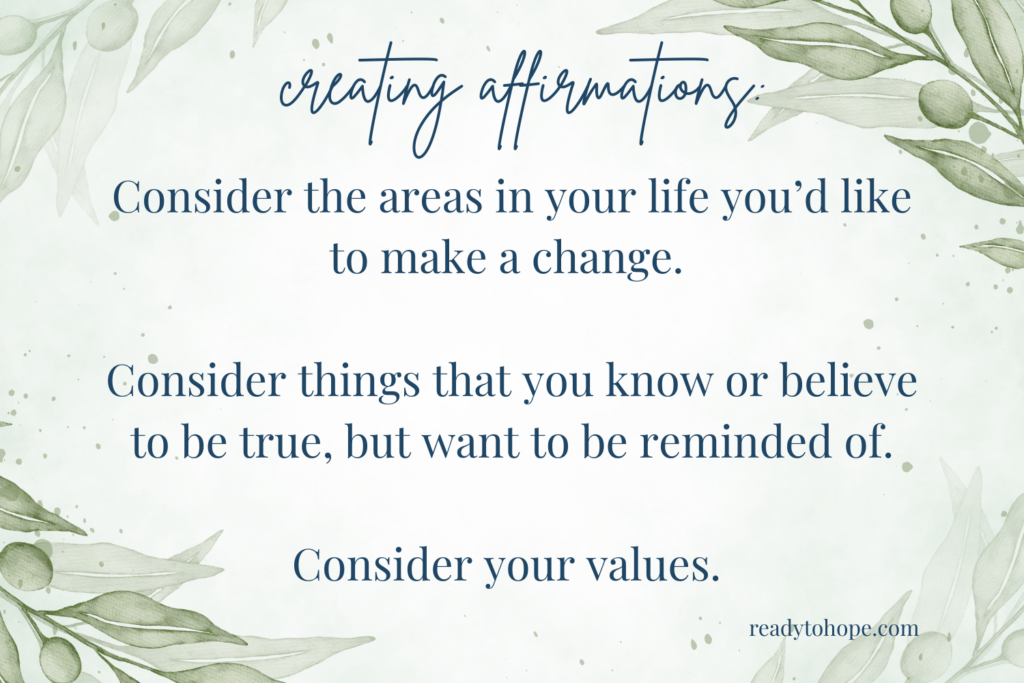
How to create your affirmations:
- Consider the areas in your life you’d like to make a change.
- Consider things that you know or believe to be true, but want to be reminded of.
- Consider your values. As a reminder, your values are the qualities that you want to present to the world. What do you want people to say about you when you leave the room? How do you want people to describe you? What do you want to be remembered for?
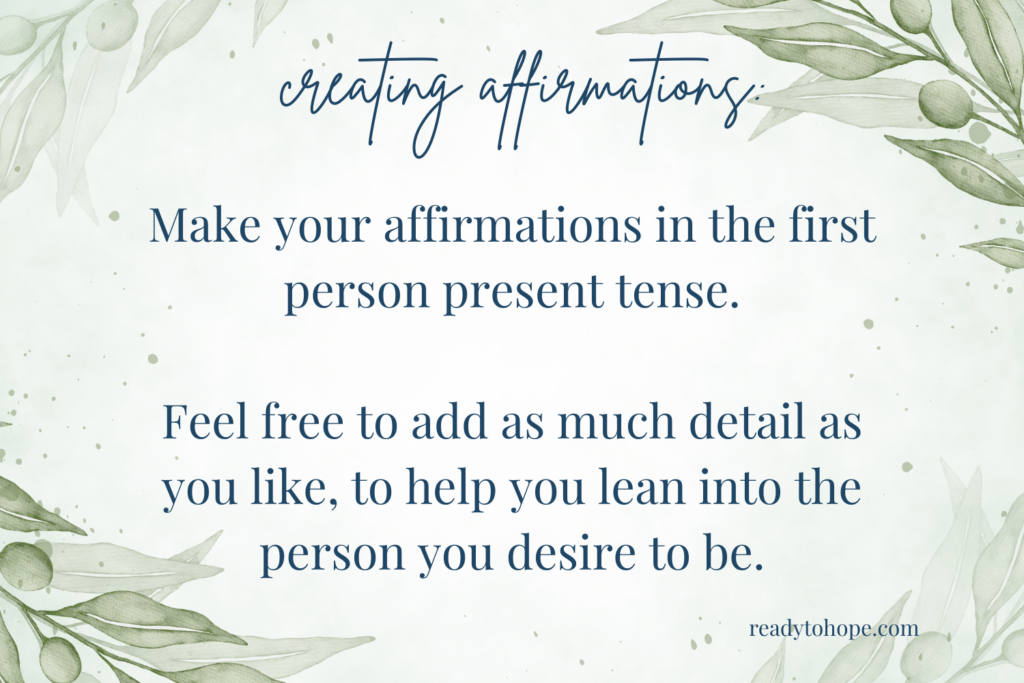
- Make your affirmations in the first person present tense. So instead of saying, “I want to feel God’s love at all times,” say something like, “I know that God loves me at all times.”
- Feel free to add as much detail as you like, to help you lean into the person you desire to be. For example, you can expand, “I know God loves me at all times” to say, “I know that God loves me like a parent, and that makes me worthy of love and pursuing the things that matter to me.”
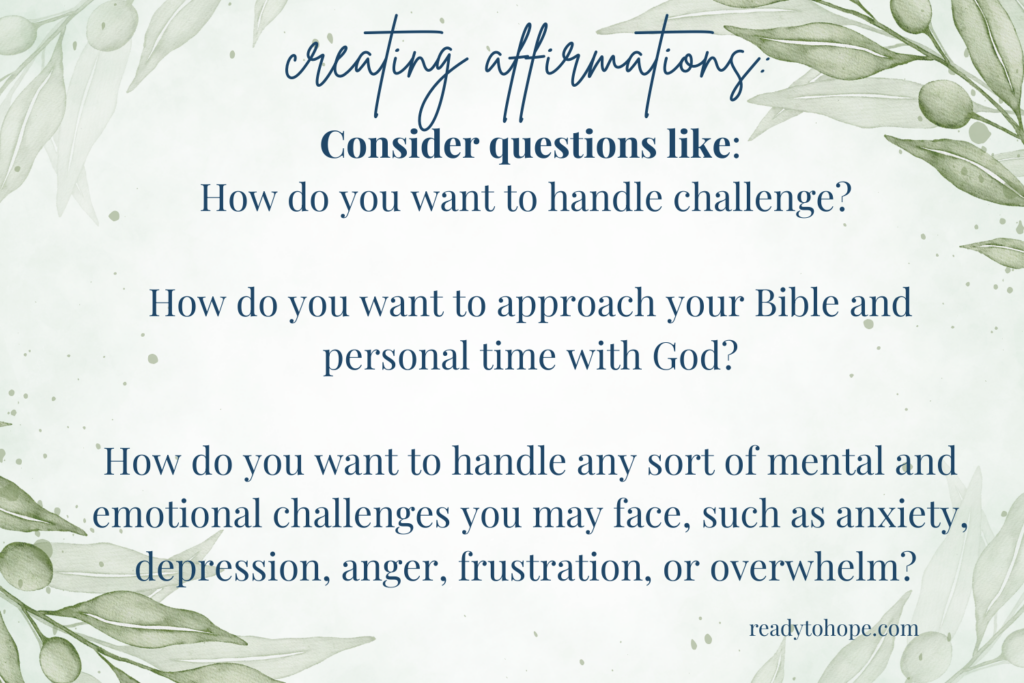
- Consider questions like:
- How do you want to handle challenge?
- How do you want to approach your Bible and personal time with God?
- How do you want to handle any sort of mental and emotional challenges you may face, such as anxiety, depression, anger, frustration, or overwhelm?
- Consider making your favorite scripture into an affirmation!
Finally, make your affirmations into a practical tool!
First, it is okay to spend some time on this. This may come easily, or you may need to give yourself a few days to work on this.
What is important: don’t rush it. Pray on it, give yourself time and space to uncover the affirmations that will help you most.
And then, turn them into a tool!
We are going to use the notecard method to get started, but of course you can feel free to find another method down the road if you find one that works best for you.
So, you’ll want to put your affirmations on 3×5 cards and then ideally use a hole punch and tie them with a ribbon, or use a ring clip. Just find a tool you like to keep them together.
And then review them, as often as possible! Maybe even make a set for your car and a set for your desk, or even a set for your bathroom or nightstand!
The more you review them, the sooner you will change your mental pathways and begin to keep your sights on things above!
We pray that this will be a meaningful exercise and one that you can be constantly updating as you find new pathways you desire to create, and even as old affirmations become so automatic that you no longer need to keep repeating them!
May God bless you as you begin to develop your divine focus on Him!
And as always, please know that we are here for your questions- we love your questions and want to connect with you! Please email us here anytime!