

Week Ten in Renewing Our Minds
These past few weeks we have been seeking to understand how we can choose the thoughts that serve our mental and spiritual wellness, by combining the principles behind Acceptance and Commitment Therapy (ACT, or ACT therapy) with diving into scripture and stories from the Bible.
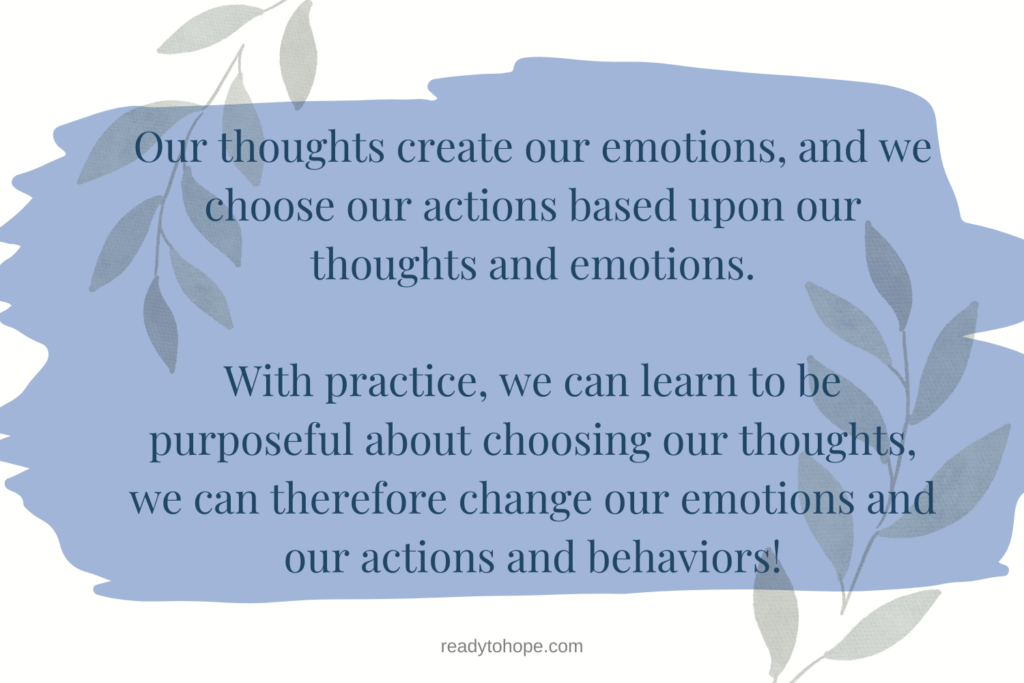
The overarching theme we have been uncovering is that our thoughts create our emotions, and we choose our actions based upon our thoughts and emotions.
And because, with practice, we can learn to be purposeful about choosing our thoughts, we can therefore change our emotions and our actions and behaviors!
Today we are going to turn our attention to using these concepts to view the world and others through the lens that serves us (and others) best.
In other words, we are going to learn how we can choose a godly perspective!
This entire study has been about how we can renew our mind and capture our thoughts, with the verses that we have drawn from being:
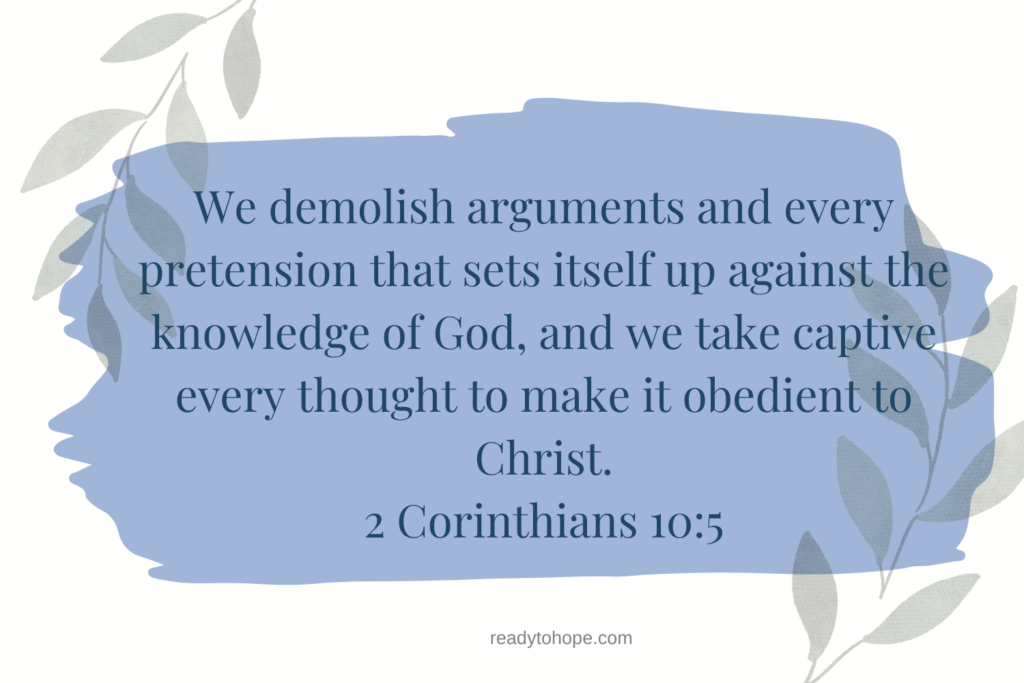
We demolish arguments and every pretension that sets itself up against the knowledge of God, and we take captive every thought to make it obedient to Christ.
2 Corinthians 10:5
And
Do not conform to the pattern of this world, but be transformed by the renewing of your mind. Then you will be able to test and approve what God’s will is—his good, pleasing and perfect will.
Romans 12:2
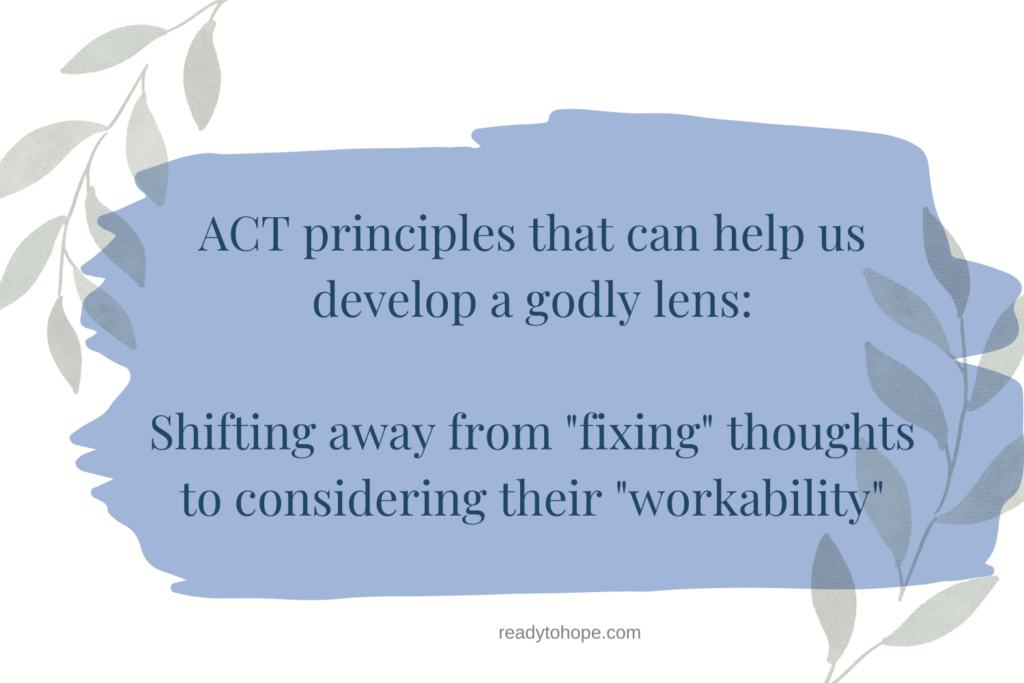
Let’s first explore the ACT principles that can help us develop a godly lens
Shifting away from “fixing” thoughts to considering their “workability”:
Instead of asking if a thought is true, ACT asks: “Is holding onto this thought working for me? Does it help me live the life I want?”.
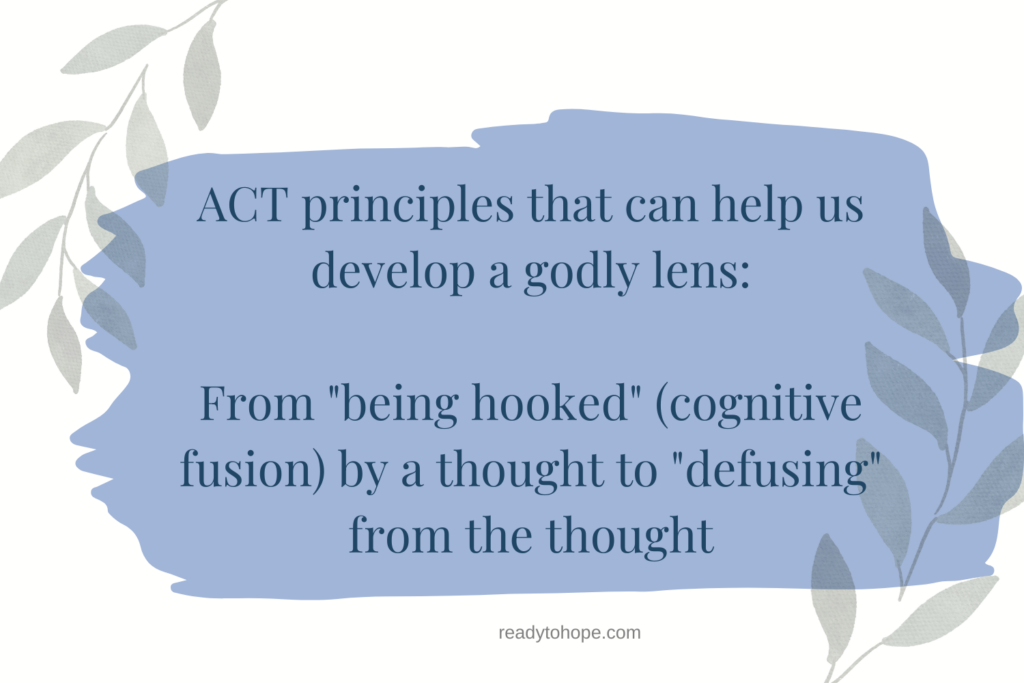
From “being hooked” (cognitive fusion) by a thought to “defusing” from the thought:
Instead of believing every thought is a command or truth, you reframe thoughts as mere words or passing sensations, reducing their power.
You can begin to consider that the thoughts are just stories that may or may not be true- and that you get to decide what you want to do with the stories, whether you want to let them pull you in and upset you, or just be a story that may or may not be true.
You can even step away from the thought by shifting for example from “I am anxious” to “I notice that I am feeling anxious.”
From “control” to “acceptance”:
Instead of trying to eliminate uncomfortable feelings, you make space for them. Rather than trying ineffective ways to run away from or numb difficult feelings, you allow them to be. You drop the struggle with them so that you can choose your next action.
Labeling stories:
If thoughts are just stories that may or may not be true, then you could even go further and say, “this is the story I tell myself about being anxious” or “this is my story about how I always fail at everything I try.”
This practice is especially helpful if you have been telling yourself stories for a long time.
For example, if you’ve always thought you weren’t good at learning you may have a story that says something like, “I am not a good student.”
But if you can defuse a bit and instead say, “this is my story about how I am not a good student”- can you feel the difference? If it’s a story, then it may be just like a fairy tale that you’ve heard a hundred times. Just because you’ve heard it over and over, doesn’t mean it isn’t still something that someone made up.
So what we know is this- there are helpful ACT concepts we can apply to how we think. And we can choose different thoughts!
Now, let’s layer in scripture, so that we can build a toolbox that helps us choose godly thoughts, more of the time!
Luke 10:25-37
Begin by taking a few moments to read over the scripture, thinking about what God wants you to learn about how we can shift our perspective, then come back!
In verse 33, the Samaritan is described as “despised.” And yet a priest and a Temple assistant, both characters we would consider godly, both walked by and didn’t help the Jewish man that had been beaten. Instead it was the despised person, the person that everyone felt perfectly okay disliking and seeing through the negative stereotype they’d come to know.
In so many ways, this story opens our eyes to the power of a change in perspective.
First, we see that those we instinctively consider kind can be selfish, and those we instinctively consider selfish can be kind. In other words- you simply never know how people may act, and trying to assume based on preconceived notions or past behaviors can be foolish.
By making the Samaritan the hero, Jesus breaks down prejudice. He shows that mercy can come from those we distrust.
The parable ultimately asks not just “who is my neighbor” but “whose neighbor am I?”
So the perspective shift here? That we can never assume someone’s heart based on their past actions, titles, or status.
Philippians 4:8
Finally, brothers and sisters, whatever is true, whatever is noble, whatever is right, whatever is pure, whatever is lovely, whatever is admirable—if anything is excellent or praiseworthy—think about such things.
True
Noble
Right
Pure
Lovely
Admirable
Excellent
Praiseworthy
In one verse, we are given a powerful tool for choosing our perspective!
It really is as simple as that: making Philippians 4:8 a filter we can apply when we find ourselves wanting to choose the thoughts that will best serve our mental and spiritual wellness- and make us better equipped to then feel those feelings we want to feel, and act in the ways we want to act.
Is it pure? Is it lovely? Is it excellent?
When you find yourself wanting to choose the godly perspective in the moment, this verse can become a lens you can use!
How can we make choosing the godly perspective a habit?
First, as always, we want to remind you that this is a practice! Just like you won’t be good at Spanish or guitar in a few weeks, you must be willing to be patient with yourself. You won’t shift automatically or overnight but the more you consider these questions and Philippians 4:8, the more you will begin to feel the shift take place.
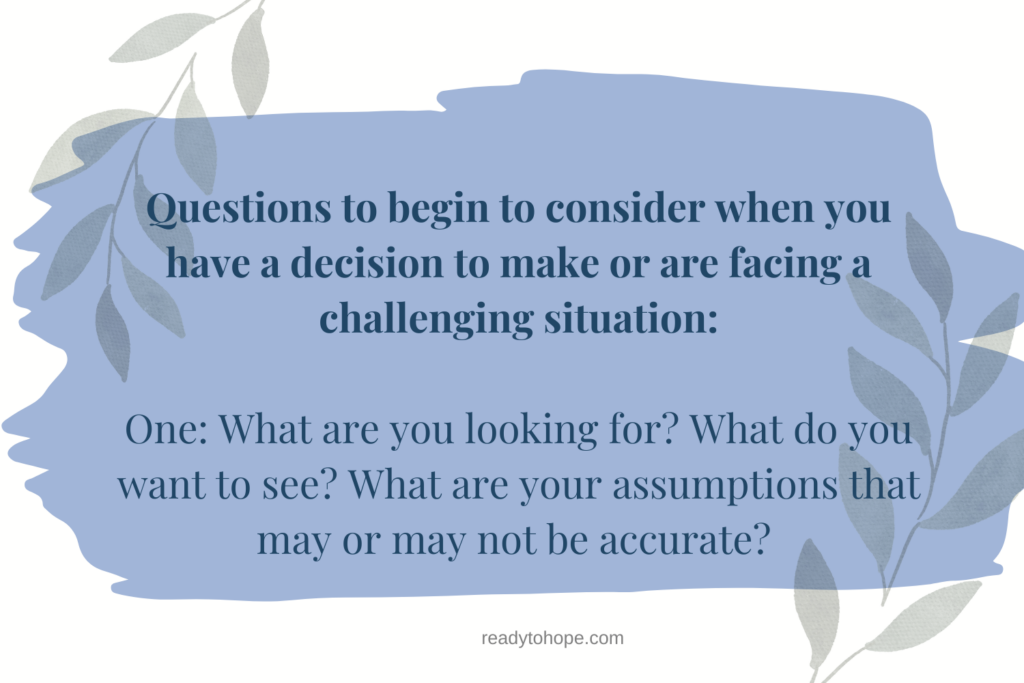
Questions to begin to consider when you have a decision to make or are facing a challenging situation:
One: What are you looking for? What do you want to see? What are your assumptions that may or may not be accurate?
Everyone is dealing with something, and most of the time it’s something we don’t see overtly.
And that includes you!
So when you think “there she goes again, being selfish and not willing to pick up that work shift” you might consider that she could be exhausted from a fight with her partner the night before. Or having just found out that her childcare fell through. Or worried for her mom’s cancer diagnosis.
When you think “I am worthless, I can’t seem to make myself get to the gym,” you might consider that your job is really demanding, or that you have taken on more commitments at church or volunteering.
In other words, this question gives you a chance to question your immediate response.
How can you look for the most positive story for why someone does what they do- including yourself?
How can you look for evidence that others are doing their best, even when it may not be what you’d like them to do? And that the same goes for you?
How can you choose to look for the godly perspective?
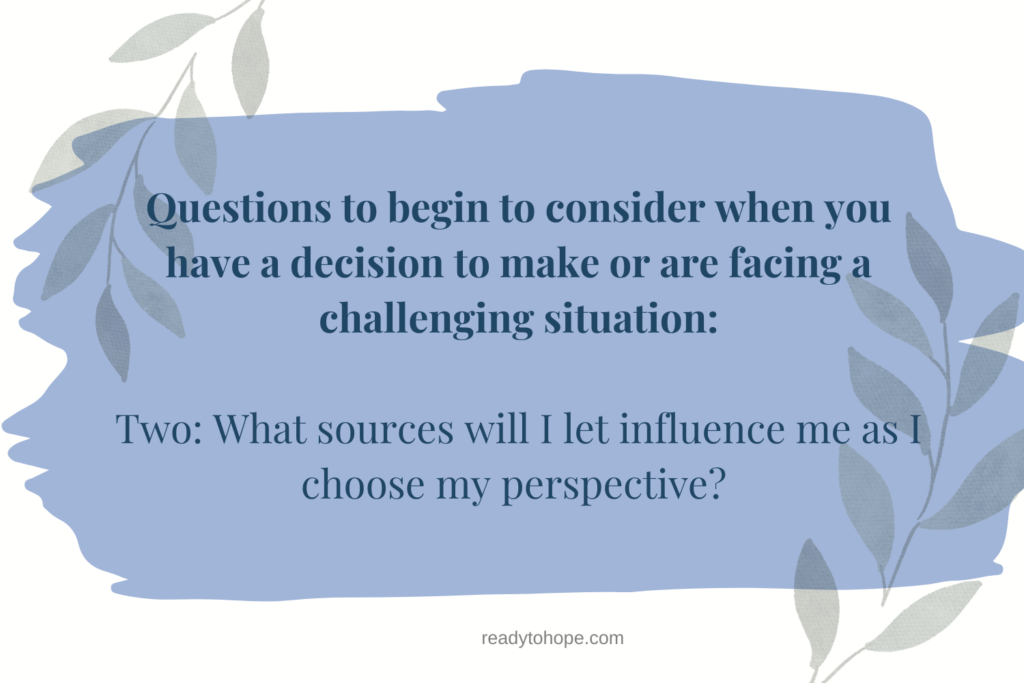
Two: What sources will I let influence me as I choose my perspective?
We have talked about in the past how social media and media are often geared to fire you up, to make you see the worst possible scenario, to see why you and the world are lacking and failing.
But the good news is- we can choose our influences. We can choose who we want to listen to.
So, what sources serve your godly perspective? And which make it harder to choose a godly perspective?
You can turn off the news. You can turn off social media. And you can consider that your parents’ unhelpful advice or judgments may be the result of their own hurts and fears, and not necessarily a source you need to let influence you. (Just as an example, of course.)
Three: Using my values to guide me, what do I want to focus on?
Here we are again, talking about values! Values are never more important than when we are considering our perspective!
Once again, you can hop back over TO THIS POST to learn more about how to define your values, and if you haven’t already defined your values, we encourage you to do that. Right now!
How do values help us choose our perspective?
As an example, if I consider my faith to be a top value of mine, then when I think about my perspective, and I remind myself how important my faith is to me, it allows me to shift back into that authentic mindset. I want to be a person who places my faith high in my life, so I need to look at any given situation through that lens.
If I consider health an important value, then when faced with a decision to skip the gym or buckle down and get myself there, I can use my value to remind myself that I want to be someone who takes care of my body- and seeing the world through that lens, suddenly it may seem a little easier to take the action.
In our next week we are going to build a card deck to help us really practice shifting our perspective and adopting a godly lens, so the work you do here this week matters!
Keep practicing, learning, and praying! And if you have any questions, know that you can REACH US HERE anytime! We want to hear from you!